Nautical kitchen island remodel
Boat detailing at domestic scale, without the anchors. What that means for a kitchen island remodel — what changes, the palette, the dimensions worth checking — and how to try it on a photo of your own room.
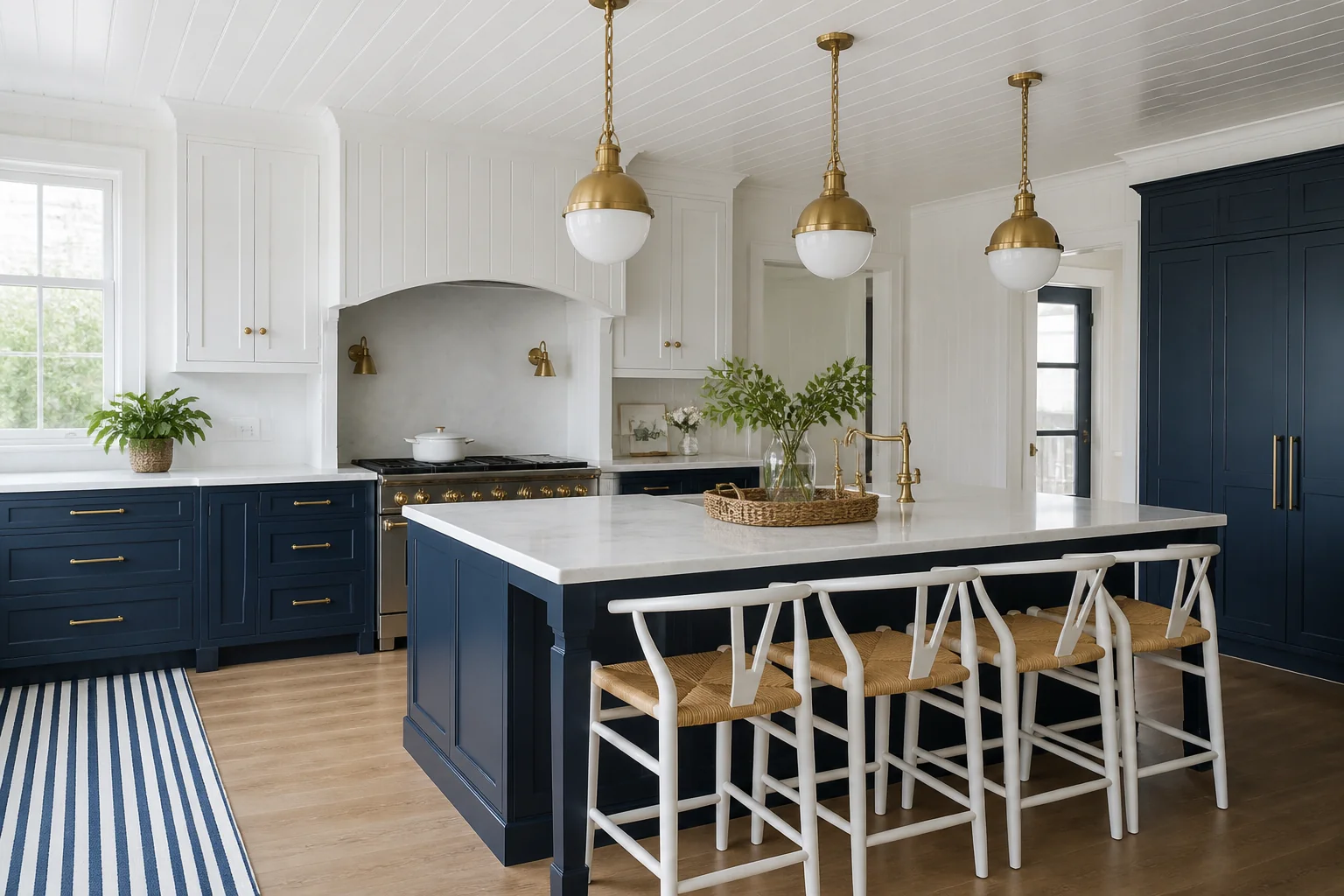
What the work actually covers
Adding or rebuilding an island is a separate project from a kitchen remodel, and a more delicate one. It succeeds or fails entirely on clearance: an island with 42in around it makes the kitchen; the same island with 32in makes an obstacle. Taken in Nautical, the elements on the list — island carcass and top, seating overhang, pendants above, power and sockets — are the ones carrying the look, and panelling. tongue and groove with well-chosen hardware is the credible version of this style.
Making a kitchen island remodel read as Nautical
Nautical done well is joinery: tongue and groove, brass fittings, rope detailing, navy against white in a restrained ratio. Done badly it is a themed room, and the line between the two is roughly the point at which motifs appear. Against a kitchen island remodel that means the pieces doing the visible work are built-in bunk or window seat, brass wall sconces, navy-and-white striped textiles, sitting inside whatever the layout already demands.
Palette and materials
Nautical holds a narrow range: Sailcloth, Rope, Brass, Harbour Navy, Deep Hull, with materials running to varnished teak and mahogany, solid brass fittings, canvas and duck cotton, rope detailing. On a kitchen island remodel the discipline matters most wherever the largest uninterrupted surface is — keep that inside the range and every smaller decision gets easier.
Dimensions that do not move
A style choice never overrides the geometry. Whatever the finishes, the work still has to hold: Leave 42in of clear floor all round; 48in on any side where an appliance door opens toward it. An island needs 4ft of length before it is worth building — below that it is a table. Allow 24in of width per seated person and 12in of knee overhang at 36in counter height.
Lighting
Brass and glass fittings with a marine profile, warm and modest. Pendants define the island but do not light it. Add a task layer — recessed or a linear fixture — directly over the working half, and keep the pendants dimmable and low-output so they read as objects rather than floodlights.
Where it usually goes wrong
The style breaks on anchor and ship-wheel decor, red as a third colour, novelty rope knots. Independent of any style, this project is most often let down by an island sized to the available floor rather than to the clearance it needs. seating on the same side as the working surface, so cooks and sitters collide.
If the space is tight
Under 13ft of kitchen width there is no room for an island with proper clearance. A peninsula gives most of the benefit and only needs clearance on three sides. Panelling. Tongue and groove with well-chosen hardware is the credible version of this style.
Questions
- Does Nautical work for a small kitchen island?
- Under 13ft of kitchen width there is no room for an island with proper clearance. A peninsula gives most of the benefit and only needs clearance on three sides. Nautical is helped by that, since boat detailing at domestic scale, without the anchors.
- Which surface matters most in a nautical kitchen island?
- Panelling. Tongue and groove with well-chosen hardware is the credible version of this style.
- Can I see this on my own kitchen island?
- Yes. Upload a photo of the room and the Studio remodels it in Nautical. New accounts get 4 credits and a Standard run costs 4, so there is a full render before anything is paid for.
- What ruins a nautical scheme?
- Usually anchor and ship-wheel decor and red as a third colour.