Organic Modern basement remodel
Modern discipline with every hard edge softened. What that means for a basement remodel — what changes, the palette, the dimensions worth checking — and how to try it on a photo of your own room.
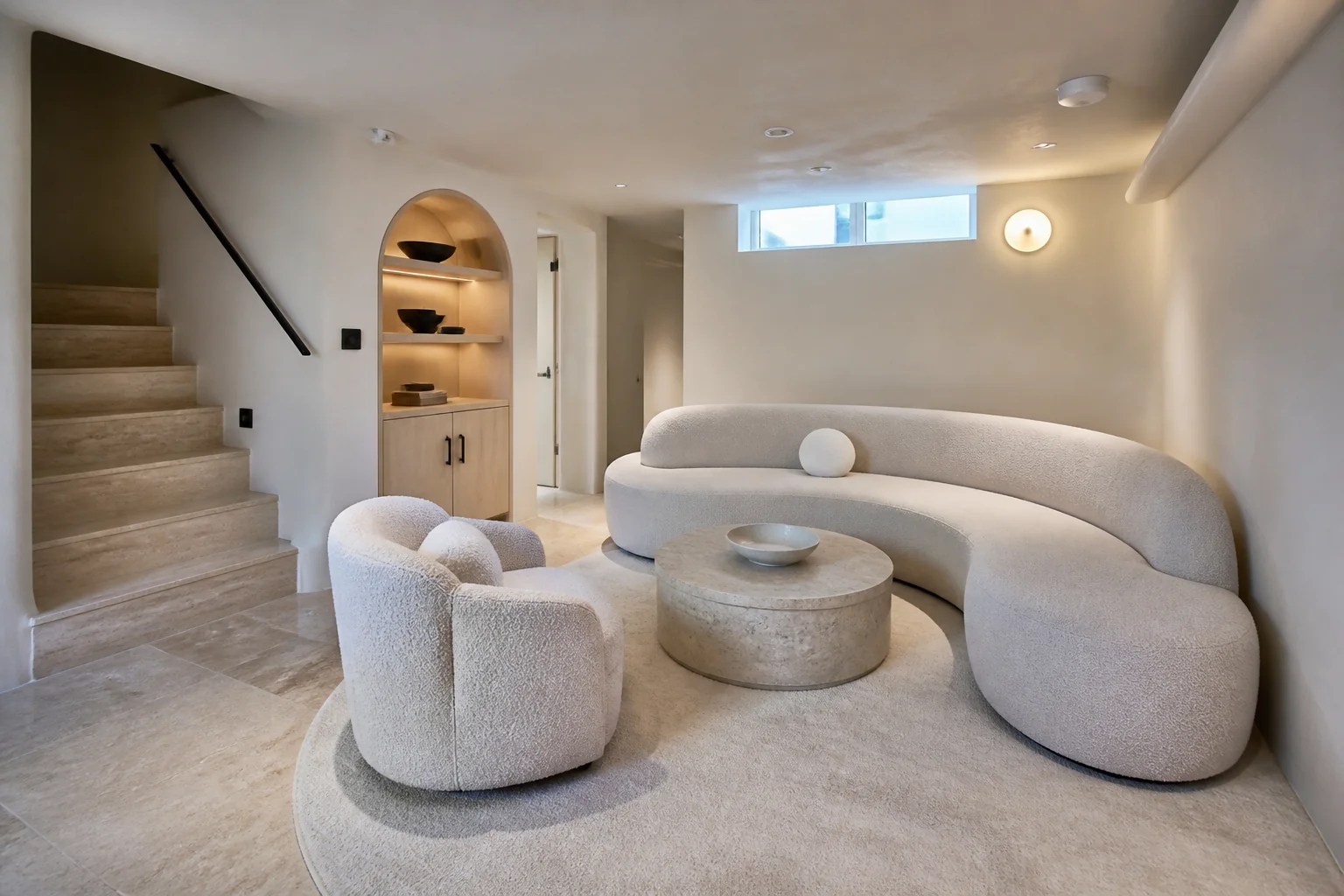
What the work actually covers
A basement remodel is a fight against two things: low ceilings and no daylight. Everything else is ordinary interior work. Win those two and the space stops reading as a basement; lose them and no amount of finish will hide it. Taken in Organic Modern, the elements on the list — ceiling treatment and height, flooring over slab, stair opening and rail, egress and window wells — are the ones carrying the look, and radii. curved reveals, rounded arrises and soft corners are the whole style; square edges revert it to modern.
Making a basement remodel read as Organic Modern
Organic modern keeps modern planning — clean lines, hidden storage — and rounds it: curved joinery, plastered forms, boucle and travertine. In a remodel it costs more than modern because curves have to be made rather than cut. Against a basement remodel that means the pieces doing the visible work are curved bouclé sofa, arched mirror, travertine or plaster coffee table, sitting inside whatever the layout already demands.
Palette and materials
Organic Modern holds a narrow range: Bone, Almond, Camel, Mushroom, Espresso, with materials running to bouclé, rounded white oak, textured plaster, travertine. On a basement remodel the discipline matters most wherever the largest uninterrupted surface is — keep that inside the range and every smaller decision gets easier.
Dimensions that do not move
A style choice never overrides the geometry. Whatever the finishes, the work still has to hold: Aim for 7ft 6in of finished ceiling; below 7ft the room feels like a cellar whatever you do. Box only what must be boxed — soffits for ducts, exposed and painted joists everywhere else. Keep 36in of clear width at the bottom of the stair before anything begins.
Lighting
Concealed ambient plus one or two sculptural pieces in plaster, paper or alabaster. Layer low. With no ceiling height to spare, recessed cans plus wall washing beats any hanging fixture — light on the walls is what makes a low room feel taller. Aim for more fixtures at lower output rather than a few bright ones.
Where it usually goes wrong
The style breaks on sharp right angles everywhere, cool greys, high-contrast black and white. Independent of any style, this project is most often let down by a dropped ceiling installed for access, costing 8in the room could not spare. recessed cans in a grid, lighting the floor and leaving the walls dark.
If the space is tight
Paint the exposed joists and services one flat dark colour and the ceiling reads as depth rather than as a low lid. It is the single highest-return move in a basement under 7ft 6in. Radii. Curved reveals, rounded arrises and soft corners are the whole style; square edges revert it to modern.
Questions
- Does Organic Modern work for a small basement?
- Paint the exposed joists and services one flat dark colour and the ceiling reads as depth rather than as a low lid. It is the single highest-return move in a basement under 7ft 6in. Organic Modern is helped by that, since modern discipline with every hard edge softened.
- Which surface matters most in a organic modern basement?
- Radii. Curved reveals, rounded arrises and soft corners are the whole style; square edges revert it to modern.
- Can I see this on my own basement?
- Yes. Upload a photo of the room and the Studio remodels it in Organic Modern. New accounts get 4 credits and a Standard run costs 4, so there is a full render before anything is paid for.
- What ruins a organic modern scheme?
- Usually sharp right angles everywhere and cool greys.