Traditional bathroom remodel
Symmetry, mouldings and furniture that matches on purpose. What that means for a bathroom remodel — what changes, the palette, the dimensions worth checking — and how to try it on a photo of your own room.
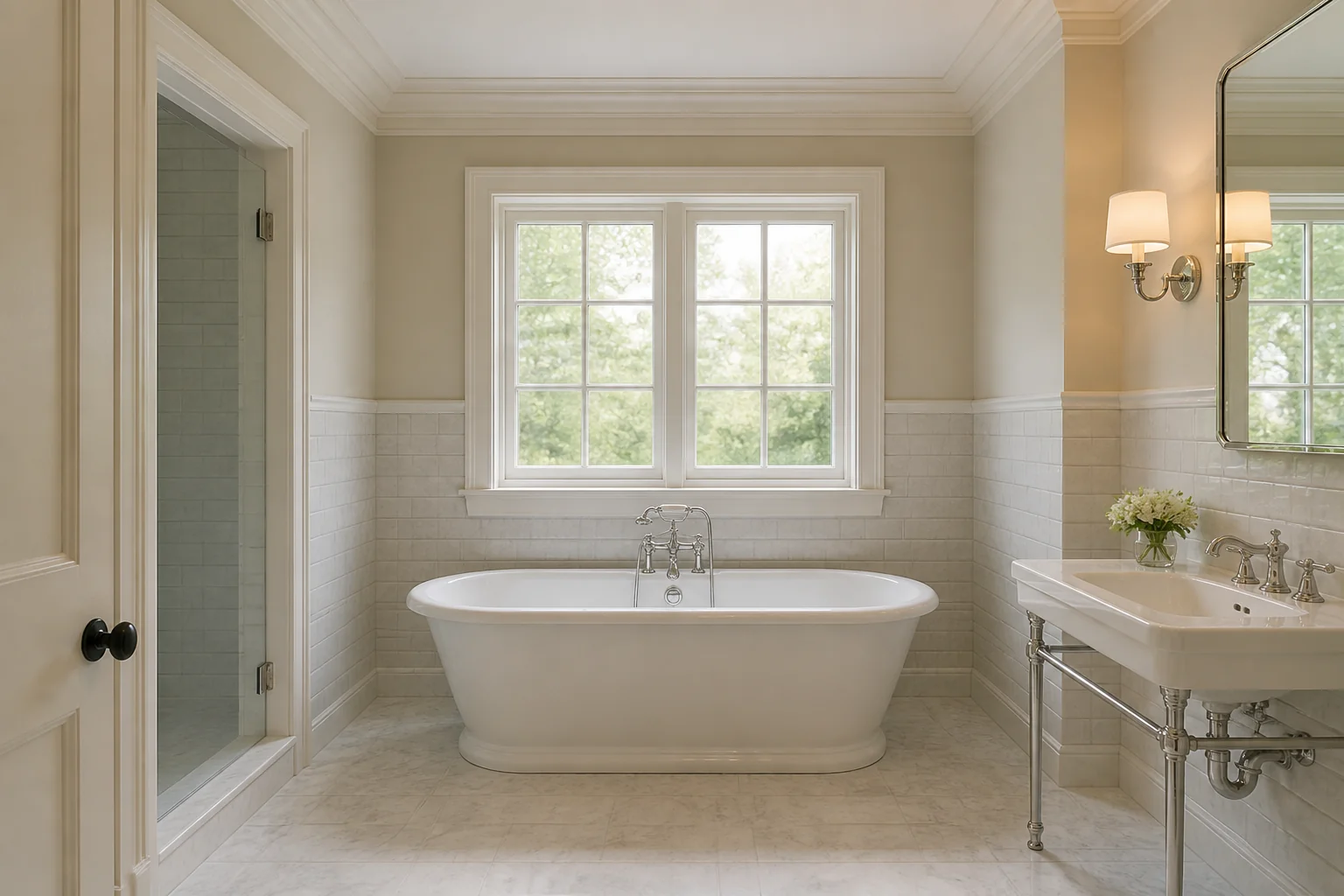
What the work actually covers
A bathroom is the one room where you can see every surface without turning your head, so the finishes have nowhere to hide. Most bathroom remodels keep the fixtures roughly where they are and change tile, vanity, lighting and glass — which is enough to make the room unrecognisable. Taken in Traditional, the elements on the list — wall and floor tile, vanity and top, mirror and lighting, shower enclosure or glass — are the ones carrying the look, and trim height and profile. traditional depends on the depth of the mouldings, which is why flat modern skirting undoes it instantly.
Making a bathroom remodel read as Traditional
Traditional is built out of profiles: skirting, architrave, panelling, cornice. A remodel reaches it by putting the mouldings back — usually the exact elements a previous renovation stripped out — and arranging the room symmetrically around a focal point. Against a bathroom remodel that means the pieces doing the visible work are rolled-arm or camelback sofa, wingback chairs in a pair, console table with mirror above, sitting inside whatever the layout already demands.
Palette and materials
Traditional holds a narrow range: Parchment, Sage, Mahogany, Navy, Burgundy, with materials running to cherry and mahogany, tufted and rolled-arm upholstery, crown moulding and wainscot, brass hardware. On a bathroom remodel the discipline matters most wherever the largest uninterrupted surface is — keep that inside the range and every smaller decision gets easier.
Dimensions that do not move
A style choice never overrides the geometry. Whatever the finishes, the work still has to hold: Leave 30in of clear width centred on the toilet, and 21in of clear floor in front of it. A shower needs 36×36in of interior floor to be comfortable; 30×30in is the practical floor. Hang the mirror so its centre sits at 62–65in — eye height for most adults.
Lighting
Table lamps and wall lights doing most of the work, a central fixture doing almost none. Warm throughout. Light the face, not the ceiling. Sconces either side of the mirror at 60–66in throw even light with no under-eye shadow; a single downlight above the mirror does the opposite. Add a separate damp-rated fixture in the shower.
Where it usually goes wrong
The style breaks on asymmetric layouts, industrial or raw materials, cool white light. Independent of any style, this project is most often let down by a ceiling light behind the person at the mirror, lighting the back of their head. large-format floor tile fought into a small room, leaving slivers at every wall.
If the space is tight
Under 40 sq ft, a wall-hung vanity and a clear glass screen instead of a framed enclosure buy back more perceived space than any tile choice. Seeing the floor run under the vanity is most of the effect. Trim height and profile. Traditional depends on the depth of the mouldings, which is why flat modern skirting undoes it instantly.
Questions
- Does Traditional work for a small bathroom?
- Under 40 sq ft, a wall-hung vanity and a clear glass screen instead of a framed enclosure buy back more perceived space than any tile choice. Seeing the floor run under the vanity is most of the effect. Traditional is helped by that, since symmetry, mouldings and furniture that matches on purpose.
- Which surface matters most in a traditional bathroom?
- Trim height and profile. Traditional depends on the depth of the mouldings, which is why flat modern skirting undoes it instantly.
- Can I see this on my own bathroom?
- Yes. Upload a photo of the room and the Studio remodels it in Traditional. New accounts get 4 credits and a Standard run costs 4, so there is a full render before anything is paid for.
- What ruins a traditional scheme?
- Usually asymmetric layouts and industrial or raw materials.