Contemporary deck remodel
Whatever is current, held together by restraint. What that means for a deck remodel — what changes, the palette, the dimensions worth checking — and how to try it on a photo of your own room.
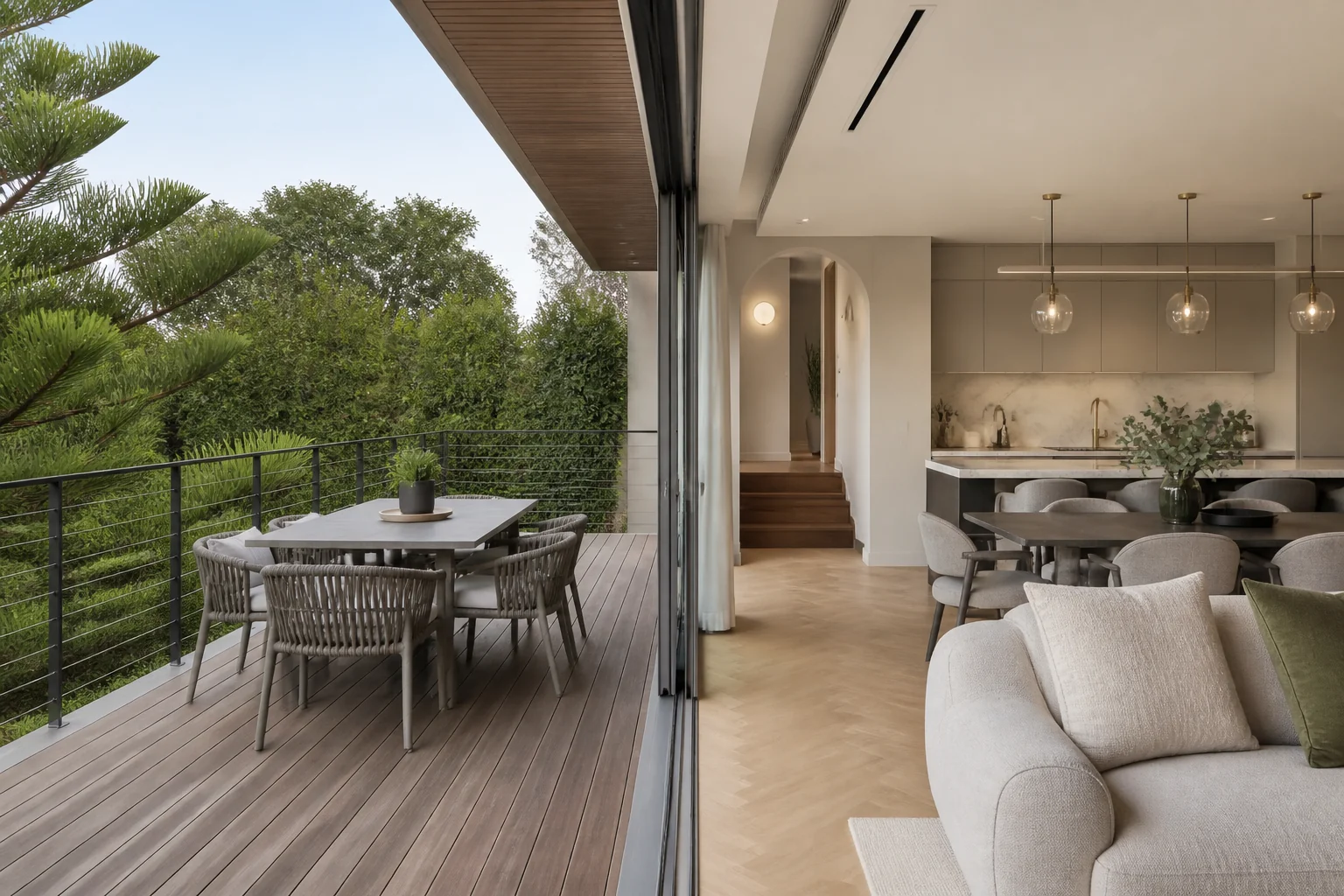
What the work actually covers
A deck remodel is decking boards, balustrade and size. The board and the rail decide how it looks; the dimensions decide whether it gets used, and most disappointing decks are simply too narrow to put a table on. Taken in Contemporary, the elements on the list — decking boards and direction, balustrade and handrail, steps and edging, built-in seating — are the ones carrying the look, and the one bold element. contemporary schemes without a single committed decision read as showhomes.
Making a deck remodel read as Contemporary
Contemporary is modern with more warmth and fewer rules: soft neutrals, curved forms, mixed metals, one strong material moment. In a remodel it is the safest brief and the hardest to make memorable, so it usually needs one deliberate risk. Against a deck remodel that means the pieces doing the visible work are curved modular sofa, sculptural accent chair, oversized artwork, sitting inside whatever the layout already demands.
Palette and materials
Contemporary holds a narrow range: Plaster, Greige, Warm Grey, Charcoal, Ochre, with materials running to bouclé, honed stone, matte black metal, fluted timber. On a deck remodel the discipline matters most wherever the largest uninterrupted surface is — keep that inside the range and every smaller decision gets easier.
Dimensions that do not move
A style choice never overrides the geometry. Whatever the finishes, the work still has to hold: A deck needs 12ft of depth to hold a dining table with chairs pulled out. At 8ft it holds two chairs. Lay boards parallel to the longest edge, or perpendicular to the house — never diagonally on a small deck. Guard rails are required above 30in of drop; keep balusters under 4in apart.
Lighting
Layered and dimmable, with at least one sculptural fixture allowed to be visible. Low and downward. Step lights, rail lights and a couple of low-level washes make a deck usable after dark without lighting the neighbours or killing the view. Anything mounted high and aimed out turns the deck into a stage.
Where it usually goes wrong
The style breaks on matching sets, small scattered artwork, more than two strong accent colours. Independent of any style, this project is most often let down by a deck sized to the budget rather than to a table, so it never holds one. boards run diagonally, which makes a small deck look busy and wastes material.
If the space is tight
Under 10ft deep, drop the dining ambition and build in perimeter seating instead. Fixed benches give a narrow deck usable capacity that loose furniture never will. The one bold element. Contemporary schemes without a single committed decision read as showhomes.
Questions
- Does Contemporary work for a small deck?
- Under 10ft deep, drop the dining ambition and build in perimeter seating instead. Fixed benches give a narrow deck usable capacity that loose furniture never will. Contemporary is helped by that, since whatever is current, held together by restraint.
- Which surface matters most in a contemporary deck?
- The one bold element. Contemporary schemes without a single committed decision read as showhomes.
- Can I see this on my own deck?
- Yes. Upload a photo of the room and the Studio remodels it in Contemporary. New accounts get 4 credits and a Standard run costs 4, so there is a full render before anything is paid for.
- What ruins a contemporary scheme?
- Usually matching sets and small scattered artwork.