Grandmillennial open concept remodel
The furnishings a grandmother would recognise, arranged with irony and skill. What that means for a open concept remodel — what changes, the palette, the dimensions worth checking — and how to try it on a photo of your own room.
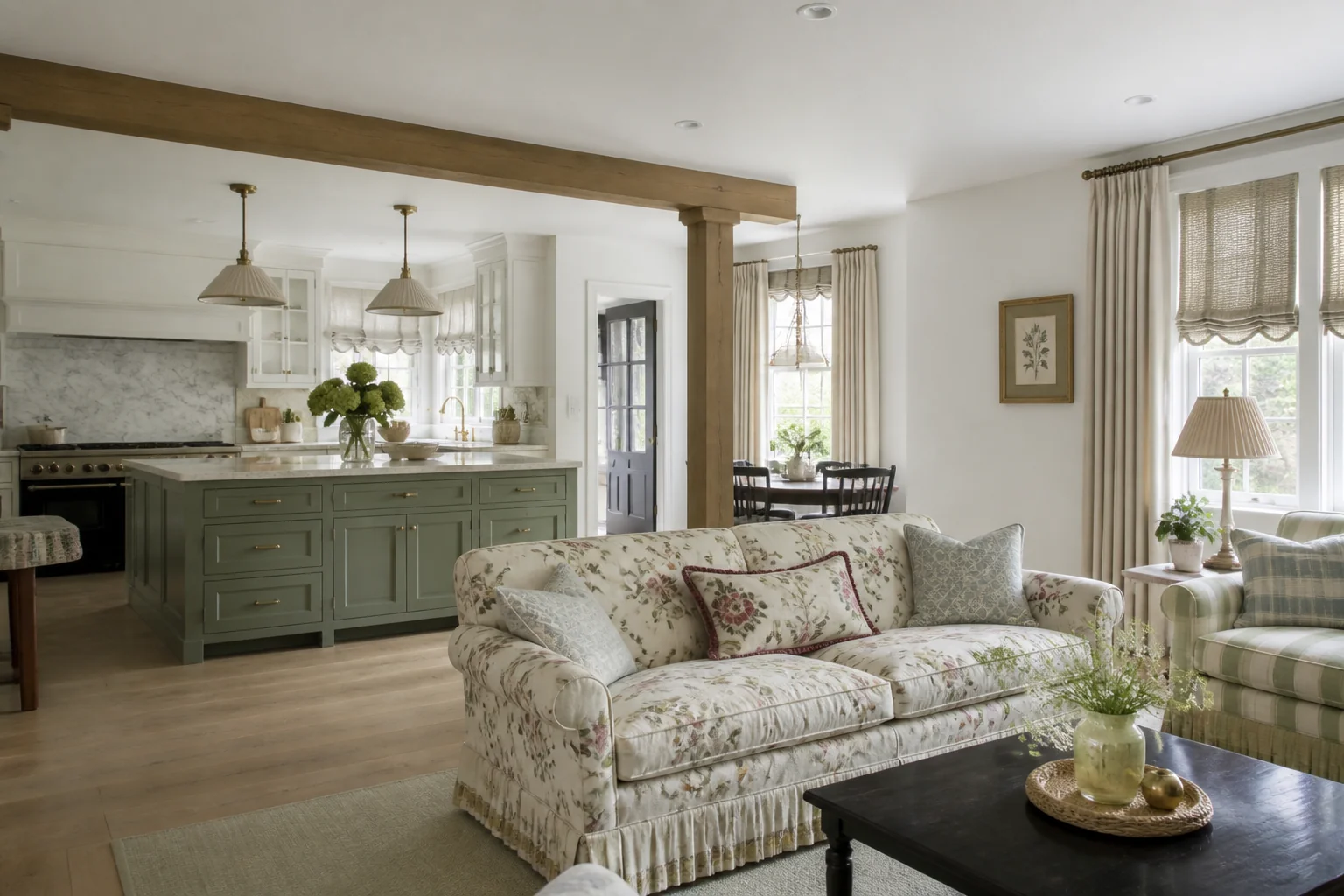
What the work actually covers
An open concept remodel is a single decision with a long tail. The wall comes out and the two rooms become one — but the beam has to go somewhere, the flooring has to reconcile, the lighting has to work as one plan, and the noise has nowhere left to stop. Taken in Grandmillennial, the elements on the list — structural wall and beam, flooring across both rooms, ceiling line, unified lighting plan — are the ones carrying the look, and wall treatment. paper or panelling is what makes it read as intentional revival rather than as an untouched room.
Making a open concept remodel read as Grandmillennial
Grandmillennial revives pattern, pleats, needlepoint and painted furniture, but edits them with contemporary discipline so the room reads as chosen rather than inherited. A remodel supports it with panelling, picture rails and walls that take paper. Against a open concept remodel that means the pieces doing the visible work are skirted side table, rattan headboard or chair, pleated lampshades, sitting inside whatever the layout already demands.
Palette and materials
Grandmillennial holds a narrow range: Chalk, Shell Pink, Grass, China Blue, Raspberry, with materials running to block-printed cotton, rattan and wicker, pleated fabric shades, painted furniture. On a open concept remodel the discipline matters most wherever the largest uninterrupted surface is — keep that inside the range and every smaller decision gets easier.
Dimensions that do not move
A style choice never overrides the geometry. Whatever the finishes, the work still has to hold: Decide early whether the beam is flush or dropped — a dropped beam is not a failure, it keeps the zones legible. Run flooring in one direction across the whole space; a change of direction at the old wall line reads as a scar. Keep 42in of route from the kitchen work zone through to the seating.
Lighting
Table lamps with pleated shades doing most of the work, warm throughout. One plan, several circuits. The kitchen half needs task light the living half must never be subjected to, so switch them separately and let the transition happen through a shared ambient layer rather than a hard line.
Where it usually goes wrong
The style breaks on cool minimal palettes, bare windows, industrial materials. Independent of any style, this project is most often let down by the wall removed and the two lighting schemes left in place, so the ceiling shows exactly where the wall was. flooring changed direction at the old wall line.
If the space is tight
Opening up a small house does not always help. Two 11ft rooms can work better than one 22ft room with no walls to place anything against — a wide cased opening often gets the light and sightlines without losing the wall. Wall treatment. Paper or panelling is what makes it read as intentional revival rather than as an untouched room.
Questions
- Does Grandmillennial work for a small open concept?
- Opening up a small house does not always help. Two 11ft rooms can work better than one 22ft room with no walls to place anything against — a wide cased opening often gets the light and sightlines without losing the wall. Grandmillennial is helped by that, since the furnishings a grandmother would recognise, arranged with irony and skill.
- Which surface matters most in a grandmillennial open concept?
- Wall treatment. Paper or panelling is what makes it read as intentional revival rather than as an untouched room.
- Can I see this on my own open concept?
- Yes. Upload a photo of the room and the Studio remodels it in Grandmillennial. New accounts get 4 credits and a Standard run costs 4, so there is a full render before anything is paid for.
- What ruins a grandmillennial scheme?
- Usually cool minimal palettes and bare windows.