Mid-Century Modern sunroom remodel
Tapered legs, warm walnut, and furniture that sits low and light. What that means for a sunroom remodel — what changes, the palette, the dimensions worth checking — and how to try it on a photo of your own room.
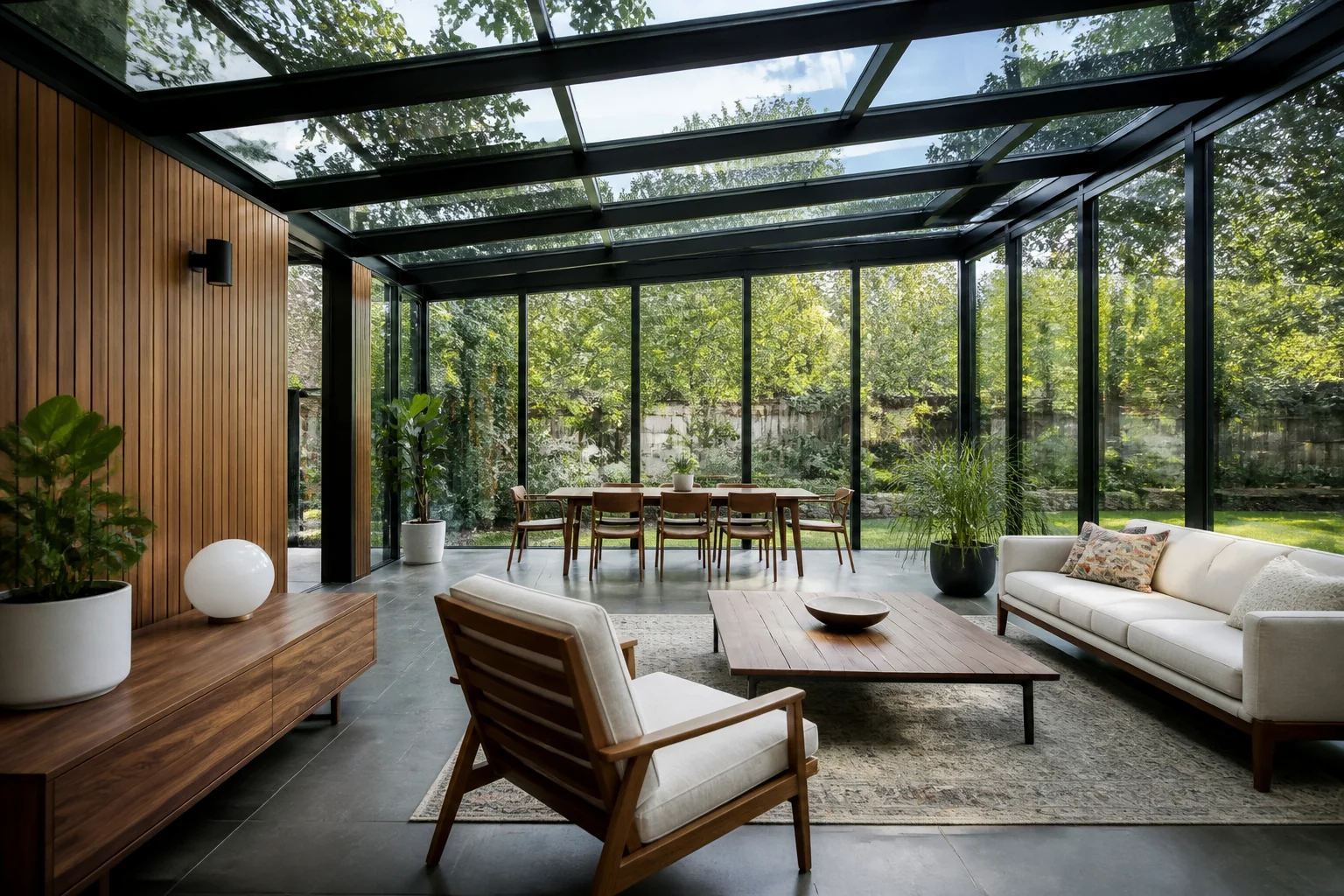
What the work actually covers
A sunroom remodel is a comfort problem. The glazing already exists; what the work adds is the ability to sit in it in July and January. Glazing spec, shading, ventilation and floor build-up decide whether the room joins the house or stays a corridor to the garden. Taken in Mid-Century Modern, the elements on the list — glazing and roof glass, shading or blinds, flooring, heating and ventilation — are the ones carrying the look, and furniture height. mid-century is defined by the gap under everything, which is why built-in storage to the floor quietly kills it.
Making a sunroom remodel read as Mid-Century Modern
Mid-century works because everything is raised on legs, so the floor runs unbroken underneath and rooms read larger than they are. A remodel gets there through warm timber, low horizontal storage and a restrained palette with one saturated accent. Against a sunroom remodel that means the pieces doing the visible work are tapered-leg sideboard, lounge chair with ottoman, sputnik or globe pendant, sitting inside whatever the layout already demands.
Palette and materials
Mid-Century Modern holds a narrow range: Bone, Mustard, Teak, Olive, Deep Teal, with materials running to walnut and teak, moulded plywood, tweed and bouclé upholstery, brass. On a sunroom remodel the discipline matters most wherever the largest uninterrupted surface is — keep that inside the range and every smaller decision gets easier.
Dimensions that do not move
A style choice never overrides the geometry. Whatever the finishes, the work still has to hold: Roof glass is the difference between a sunroom and a conservatory that overheats — spec solar-control glass or accept blinds. A roof pitch of at least 15° keeps rain moving and stops debris settling. Keep the floor level with the adjoining room; a step down makes it a separate space forever.
Lighting
Sculptural fixtures treated as objects — a globe pendant, an arc floor lamp. The fitting is meant to be looked at. The room is a light source by day and a black mirror at night. Put the lighting low — floor and table lamps — so the glass reflects a lit room rather than an array of ceiling fixtures, and the garden stays visible after dark.
Where it usually goes wrong
The style breaks on heavy skirted furniture, cool grey palettes, reproduction pieces mixed with visible modern ones. Independent of any style, this project is most often let down by clear roof glass with no shading, making the room unusable from may to september. a single step down to the sunroom, which quietly stops it being part of the house.
If the space is tight
A small sunroom that is level, heated and shaded gets used every day. A large one that is none of those things gets used twice a year — the comfort spend beats the square footage every time. Furniture height. Mid-century is defined by the gap under everything, which is why built-in storage to the floor quietly kills it.
Questions
- Does Mid-Century Modern work for a small sunroom?
- A small sunroom that is level, heated and shaded gets used every day. A large one that is none of those things gets used twice a year — the comfort spend beats the square footage every time. Mid-Century Modern is helped by that, since tapered legs, warm walnut, and furniture that sits low and light.
- Which surface matters most in a mid-century modern sunroom?
- Furniture height. Mid-century is defined by the gap under everything, which is why built-in storage to the floor quietly kills it.
- Can I see this on my own sunroom?
- Yes. Upload a photo of the room and the Studio remodels it in Mid-Century Modern. New accounts get 4 credits and a Standard run costs 4, so there is a full render before anything is paid for.
- What ruins a mid-century modern scheme?
- Usually heavy skirted furniture and cool grey palettes.