Modern wine cellar remodel
Flat fronts, long lines, and nothing applied that does not do a job. What that means for a wine cellar remodel — what changes, the palette, the dimensions worth checking — and how to try it on a photo of your own room.
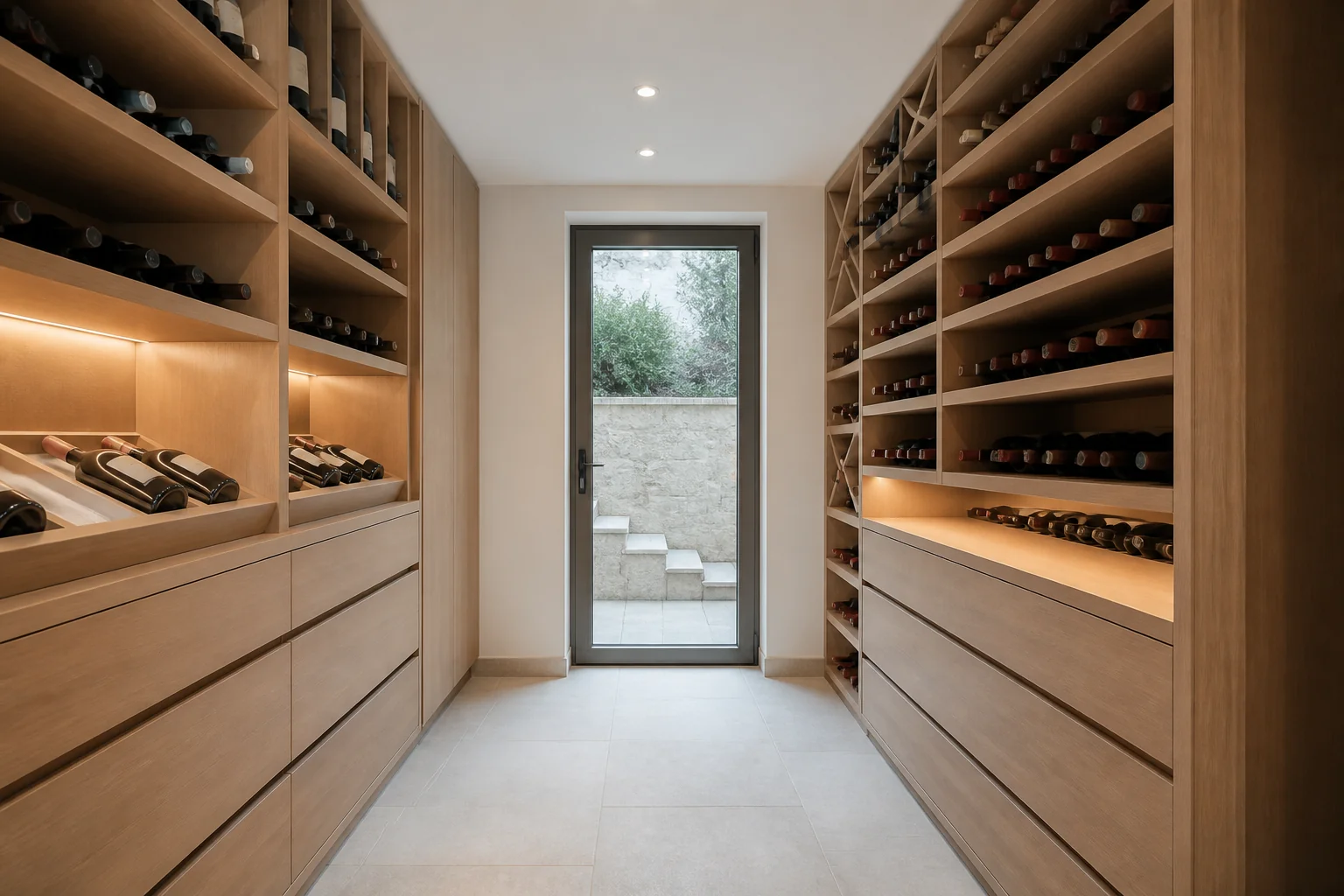
What the work actually covers
A wine room is an insulated box with racking in it. The build is about keeping a stable temperature and humidity — which decides the door, the lining and where it can go — and only then about how the bottles are displayed. Taken in Modern, the elements on the list — insulation and vapour barrier, racking layout, cooling unit, door and seal — are the ones carrying the look, and cabinet fronts and the junction between materials. modern lives or dies on how surfaces meet, so the reveals and shadow gaps matter more than the finishes themselves.
Making a wine cellar remodel read as Modern
Modern is the easiest style to reach in a remodel because it is mostly subtraction: handleless doors, a continuous counter, trim reduced to a shadow gap. The discipline is holding the line once the work is done, since every added object reads loudly against it. Against a wine cellar remodel that means the pieces doing the visible work are low-slung modular sofa, flat-panel storage wall, glass or steel-frame coffee table, sitting inside whatever the layout already demands.
Palette and materials
Modern holds a narrow range: Gallery White, Pale Ash, Concrete, Slate, Graphite, with materials running to matte lacquer, brushed steel, pale oak veneer, tempered glass. On a wine cellar remodel the discipline matters most wherever the largest uninterrupted surface is — keep that inside the range and every smaller decision gets easier.
Dimensions that do not move
A style choice never overrides the geometry. Whatever the finishes, the work still has to hold: Racking is 12in deep for a single bottle, 24in for a double-depth run. Leave 36in of aisle; a tasting table needs 60in around it, which most rooms cannot give. An insulated door with a full perimeter seal is not optional — it is the whole thermal envelope.
Lighting
Recessed and linear, positioned so the fittings disappear and only the light is visible. Warm enough to stop the flat surfaces reading cold. LED only, and as little of it as does the job — heat is the enemy and traditional lamps put it straight into the room. Light the labels from the front rather than washing the racks, and put everything on a switch that is off by default.
Where it usually goes wrong
The style breaks on ornate mouldings and carved detail, busy florals, visible clutter on open surfaces. Independent of any style, this project is most often let down by a converted cupboard with no vapour barrier, so the surrounding structure takes the moisture. a cooling unit exhausting into the same space it is cooling.
If the space is tight
A 4×6ft room, properly sealed and cooled, holds several hundred bottles and works. A large room that is not sealed is just a cold cupboard with an expensive door. Cabinet fronts and the junction between materials. Modern lives or dies on how surfaces meet, so the reveals and shadow gaps matter more than the finishes themselves.
Questions
- Does Modern work for a small wine cellar?
- A 4×6ft room, properly sealed and cooled, holds several hundred bottles and works. A large room that is not sealed is just a cold cupboard with an expensive door. Modern is helped by that, since flat fronts, long lines, and nothing applied that does not do a job.
- Which surface matters most in a modern wine cellar?
- Cabinet fronts and the junction between materials. Modern lives or dies on how surfaces meet, so the reveals and shadow gaps matter more than the finishes themselves.
- Can I see this on my own wine cellar?
- Yes. Upload a photo of the room and the Studio remodels it in Modern. New accounts get 4 credits and a Standard run costs 4, so there is a full render before anything is paid for.
- What ruins a modern scheme?
- Usually ornate mouldings and carved detail and busy florals.