Moroccan pantry remodel
Tile, arch and lantern, layered until the room is enclosed. What that means for a pantry remodel — what changes, the palette, the dimensions worth checking — and how to try it on a photo of your own room.
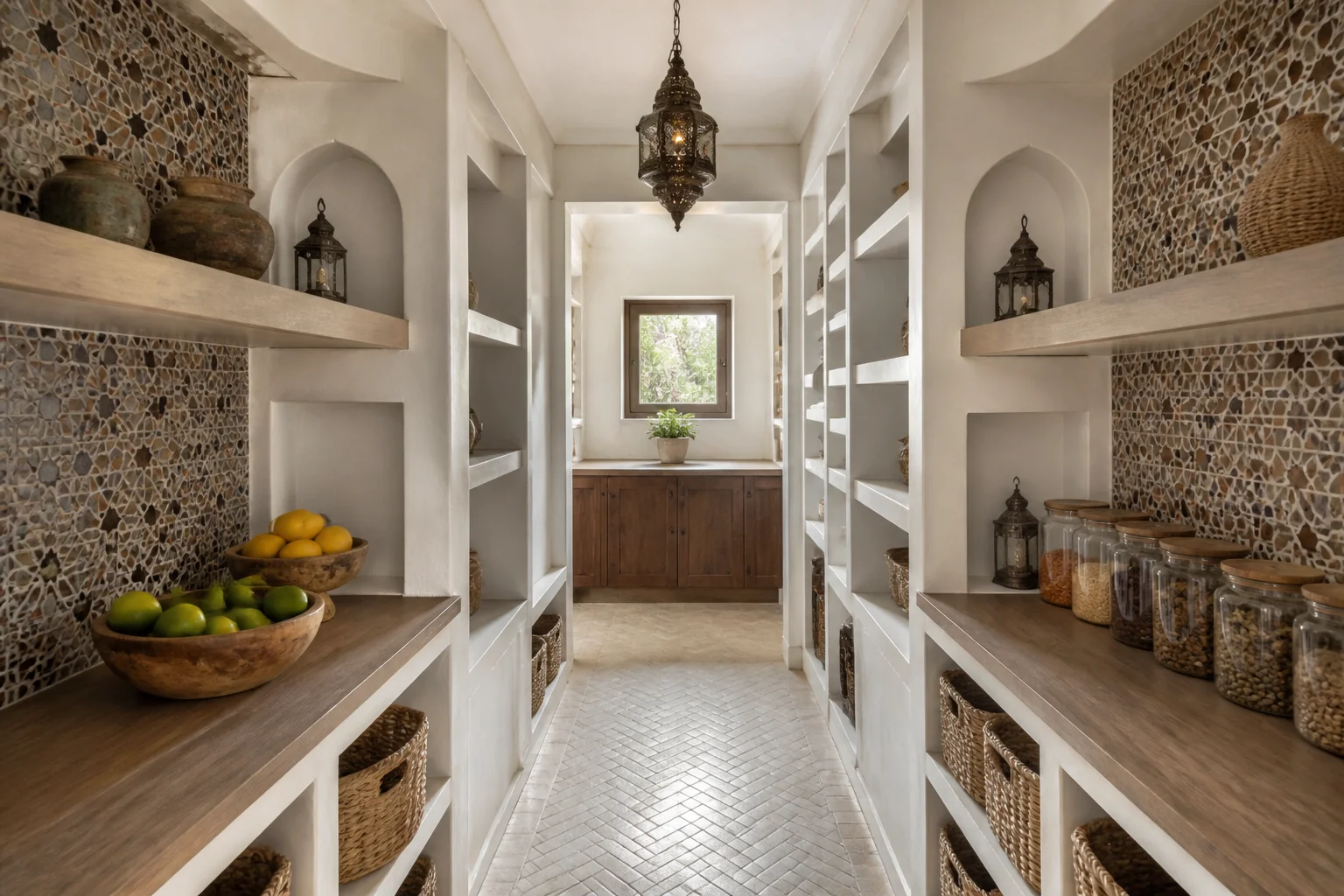
What the work actually covers
A pantry remodel is a shelving problem wearing a joinery costume. Get the depths right and everything is visible and reachable; get them wrong and you have built a place for things to go missing behind other things. Taken in Moroccan, the elements on the list — shelf depths and spacing, door type, lighting, counter or landing surface — are the ones carrying the look, and tile and arch. zellige and a shaped opening carry the whole style, and no textile substitutes for them.
Making a pantry remodel read as Moroccan
Moroccan interiors are pattern applied architecturally — zellige tile, carved plaster, arched niches — rather than pattern applied as decoration. The remodel is tiling and openings; the textiles come afterwards. Against a pantry remodel that means the pieces doing the visible work are low banquette seating, pierced metal lanterns, berber or beni ourain rug, sitting inside whatever the layout already demands.
Palette and materials
Moroccan holds a narrow range: Sand White, Saffron, Rust, Teal Glaze, Indigo, with materials running to zellige tile, carved plaster and wood, pierced brass, wool rugs and poufs. On a pantry remodel the discipline matters most wherever the largest uninterrupted surface is — keep that inside the range and every smaller decision gets easier.
Dimensions that do not move
A style choice never overrides the geometry. Whatever the finishes, the work still has to hold: Keep shelves at 12–14in deep. At 16in and beyond, the back row is invisible and effectively lost. Vary the spacing: 16in at the bottom for appliances, 10–12in in the middle, 8in above for tins. A walk-in needs 36in of clear aisle; below that you cannot turn with a box.
Lighting
Pierced metal lanterns throwing patterned shadow. Light as another form of pattern. Light inside the pantry, never from the room outside — standing in your own shadow is the defining pantry experience. A door-triggered strip on the front edge of each shelf costs almost nothing and fixes it.
Where it usually goes wrong
The style breaks on sparse modern furniture, cool white walls with no texture, recessed downlights. Independent of any style, this project is most often let down by deep shelves that swallow everything behind the front row. uniform shelf spacing, so tall items live on the floor.
If the space is tight
A reach-in pantry beats a walk-in under 20 sq ft. A walk-in spends a third of its floor on standing room; a reach-in spends none. Tile and arch. Zellige and a shaped opening carry the whole style, and no textile substitutes for them.
Questions
- Does Moroccan work for a small pantry?
- A reach-in pantry beats a walk-in under 20 sq ft. A walk-in spends a third of its floor on standing room; a reach-in spends none. Moroccan is helped by that, since tile, arch and lantern, layered until the room is enclosed.
- Which surface matters most in a moroccan pantry?
- Tile and arch. Zellige and a shaped opening carry the whole style, and no textile substitutes for them.
- Can I see this on my own pantry?
- Yes. Upload a photo of the room and the Studio remodels it in Moroccan. New accounts get 4 credits and a Standard run costs 4, so there is a full render before anything is paid for.
- What ruins a moroccan scheme?
- Usually sparse modern furniture and cool white walls with no texture.