Rustic patio remodel
Heavy timber, rough stone, and marks left where they fell. What that means for a patio remodel — what changes, the palette, the dimensions worth checking — and how to try it on a photo of your own room.
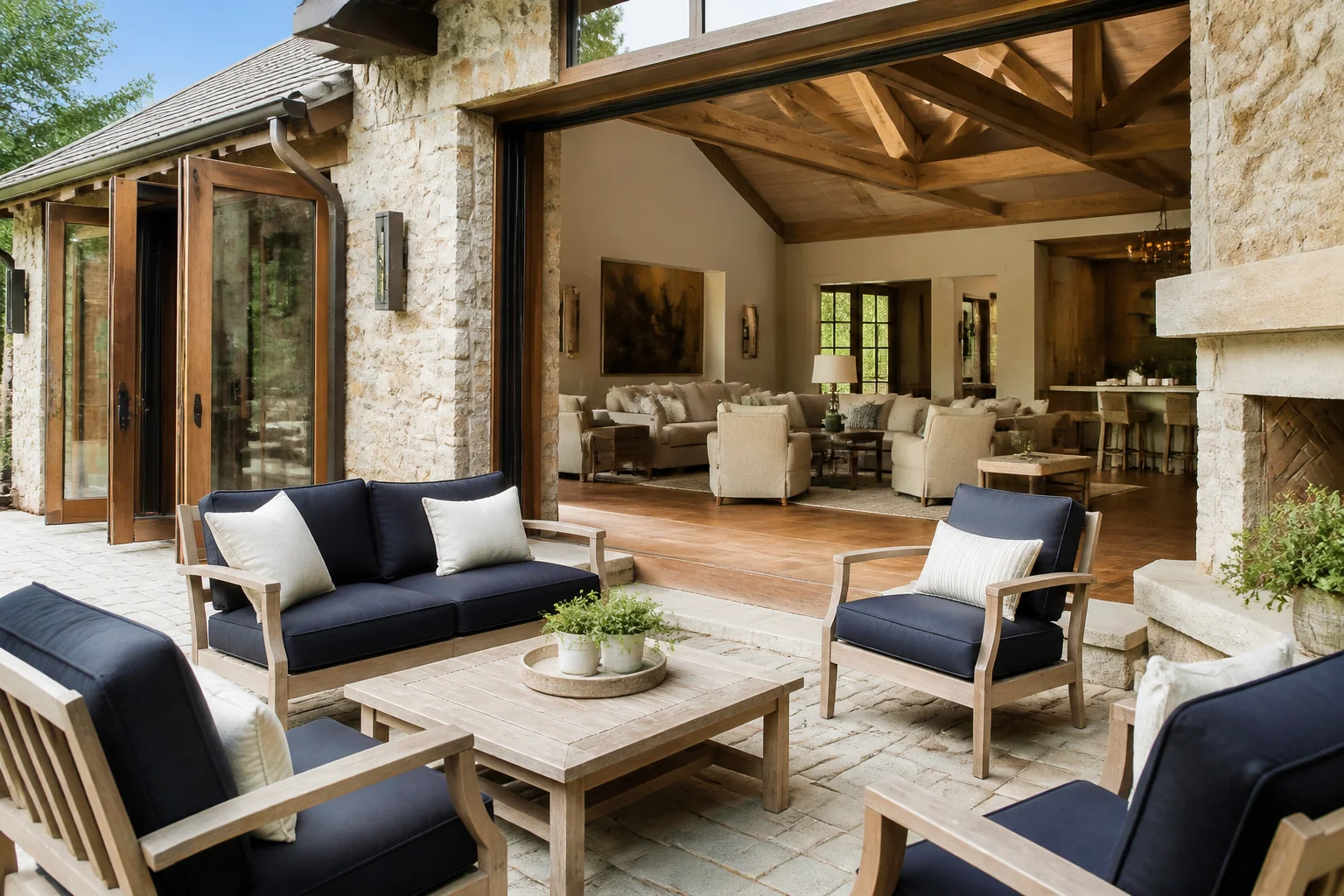
What the work actually covers
A patio remodel is a surface and a boundary. The paving format sets the character, the edge detail decides whether it looks finished, and the fall decides whether it is usable the day after rain. Taken in Rustic, the elements on the list — paving material and format, edging and borders, levels and drainage falls, built-in seating or walls — are the ones carrying the look, and ceiling and hearth. beams and a stone surround do more than every other surface combined.
Making a patio remodel read as Rustic
Rustic wants weight and texture: beams with real section, stone with real depth, timber that is finished rather than perfected. A remodel that fakes it with thin veneers reads immediately, because the whole style is about mass. Against a patio remodel that means the pieces doing the visible work are stone fireplace, exposed ceiling beams, oversized timber dining table, sitting inside whatever the layout already demands.
Palette and materials
Rustic holds a narrow range: Limewash, Wheat, River Stone, Timber Brown, Bark, with materials running to rough-sawn timber, fieldstone, hammered iron, sheepskin and hide. On a patio remodel the discipline matters most wherever the largest uninterrupted surface is — keep that inside the range and every smaller decision gets easier.
Dimensions that do not move
A style choice never overrides the geometry. Whatever the finishes, the work still has to hold: Fall away from the house at roughly 1:80 — flat paving holds water against the wall. Keep the paved surface at least 6in below any damp course. A dining patio needs 12×12ft to hold a six-seat table with chairs out.
Lighting
Warm, low and slightly uneven. Wrought iron, aged brass, and light that pools rather than spreads. Wash the boundaries rather than the middle. Lighting the walls and planting that surround a patio makes it feel like a room; lighting the paving itself makes it feel like a car park.
Where it usually goes wrong
The style breaks on glossy finishes, cool grey palettes, delicate spindly furniture. Independent of any style, this project is most often let down by a patio laid dead level, so it puddles and stains. paving brought up above the damp course.
If the space is tight
On a small patio, run the paving in one direction and take it right to the boundary. Borders and inset patterns eat the area visually and make a modest patio look smaller than it is. Ceiling and hearth. Beams and a stone surround do more than every other surface combined.
Questions
- Does Rustic work for a small patio?
- On a small patio, run the paving in one direction and take it right to the boundary. Borders and inset patterns eat the area visually and make a modest patio look smaller than it is. Rustic is helped by that, since heavy timber, rough stone, and marks left where they fell.
- Which surface matters most in a rustic patio?
- Ceiling and hearth. Beams and a stone surround do more than every other surface combined.
- Can I see this on my own patio?
- Yes. Upload a photo of the room and the Studio remodels it in Rustic. New accounts get 4 credits and a Standard run costs 4, so there is a full render before anything is paid for.
- What ruins a rustic scheme?
- Usually glossy finishes and cool grey palettes.