Transitional mudroom remodel
Traditional bones, contemporary surfaces, neither winning. What that means for a mudroom remodel — what changes, the palette, the dimensions worth checking — and how to try it on a photo of your own room.
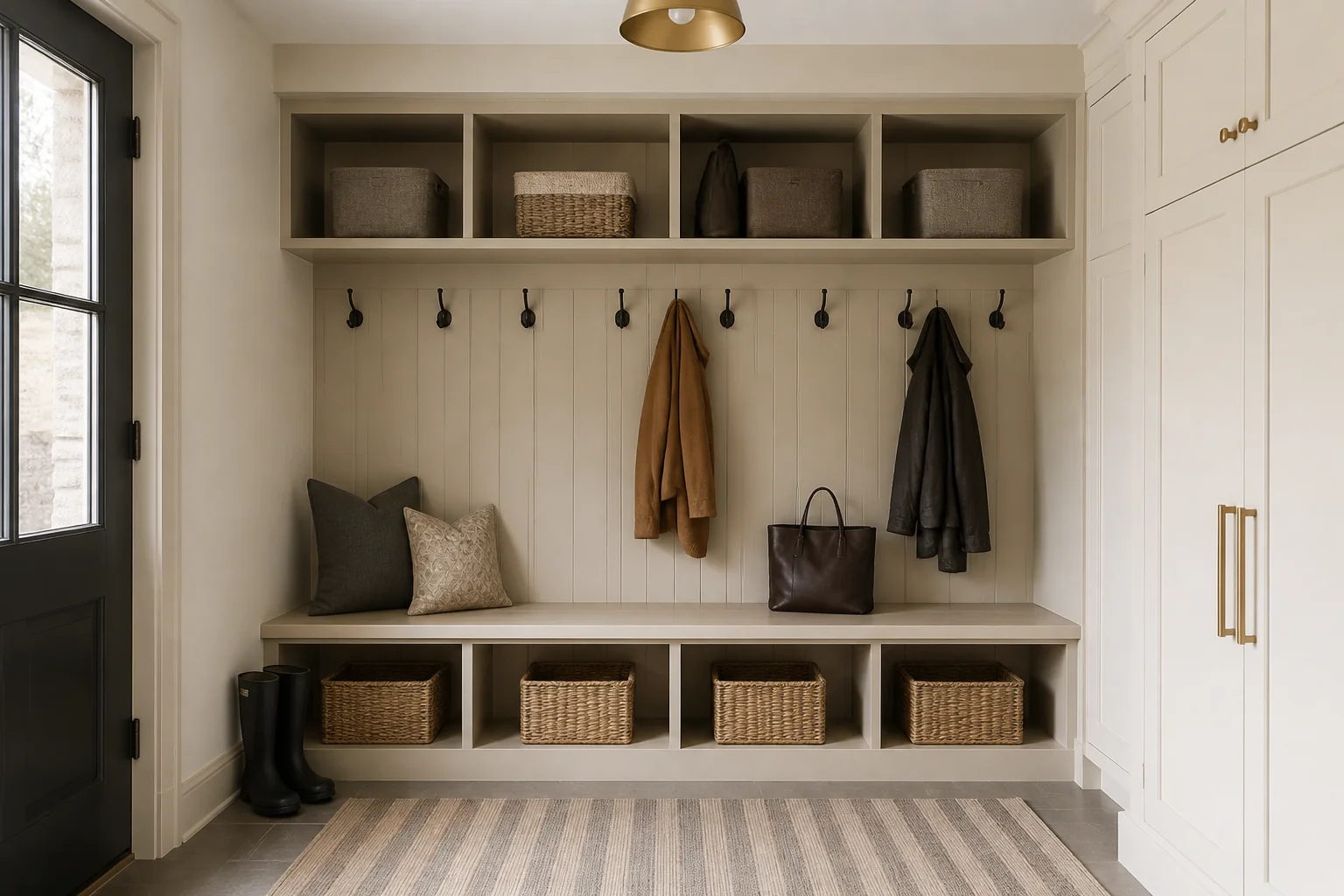
What the work actually covers
A mudroom is a piece of joinery in a corridor. Bench, hooks, boot storage, one cupboard for the things that have nowhere else — sized to the number of people who use the door, not to the wall it sits on. Taken in Transitional, the elements on the list — bench and boot storage, hooks and rail, lockers or cubbies, durable flooring — are the ones carrying the look, and trim. simplified profiles in a period-correct position is the entire trick.
Making a mudroom remodel read as Transitional
Transitional keeps mouldings and symmetry but flattens the profiles and drops the pattern, giving rooms that read as calm rather than as either period or new. It is the most forgiving style for a whole-house remodel, since it tolerates old and new rooms side by side. Against a mudroom remodel that means the pieces doing the visible work are rolled-arm sofa in plain fabric, simplified wingback or slipper chair, neutral patterned rug, sitting inside whatever the layout already demands.
Palette and materials
Transitional holds a narrow range: Ivory, Greige, Taupe, Pewter, Espresso, with materials running to painted and stained wood, linen and cotton blends, brushed nickel, marble. On a mudroom remodel the discipline matters most wherever the largest uninterrupted surface is — keep that inside the range and every smaller decision gets easier.
Dimensions that do not move
A style choice never overrides the geometry. Whatever the finishes, the work still has to hold: Allow 12in of hook width per person — closer and coats compress into one mass. A bench at 18in high and 16in deep is right for putting shoes on; deeper becomes a seat nobody clears. Leave 36in of circulation in front of the bench.
Lighting
Simple shapes in mixed metals, layered from ceiling to table. Bright and immediate. A mudroom is used in the ten seconds after coming in, usually with full hands, so put it on a motion sensor or a switch at the door and skip anything that needs adjusting.
Where it usually goes wrong
The style breaks on heavy carving, high-contrast colour schemes, trend-specific pieces. Independent of any style, this project is most often let down by joinery sized to the available wall rather than to the household, so it is full on day one. a bench too deep to sit on comfortably and too shallow to store under.
If the space is tight
With less than 5ft of wall, drop the bench and take the full height for hooks and a shelf. A cramped bench you have to shuffle around is worse than none. Trim. Simplified profiles in a period-correct position is the entire trick.
Questions
- Does Transitional work for a small mudroom?
- With less than 5ft of wall, drop the bench and take the full height for hooks and a shelf. A cramped bench you have to shuffle around is worse than none. Transitional is helped by that, since traditional bones, contemporary surfaces, neither winning.
- Which surface matters most in a transitional mudroom?
- Trim. Simplified profiles in a period-correct position is the entire trick.
- Can I see this on my own mudroom?
- Yes. Upload a photo of the room and the Studio remodels it in Transitional. New accounts get 4 credits and a Standard run costs 4, so there is a full render before anything is paid for.
- What ruins a transitional scheme?
- Usually heavy carving and high-contrast colour schemes.