Wabi-Sabi entryway remodel
Imperfect surfaces, left as they are. What that means for a entryway remodel — what changes, the palette, the dimensions worth checking — and how to try it on a photo of your own room.
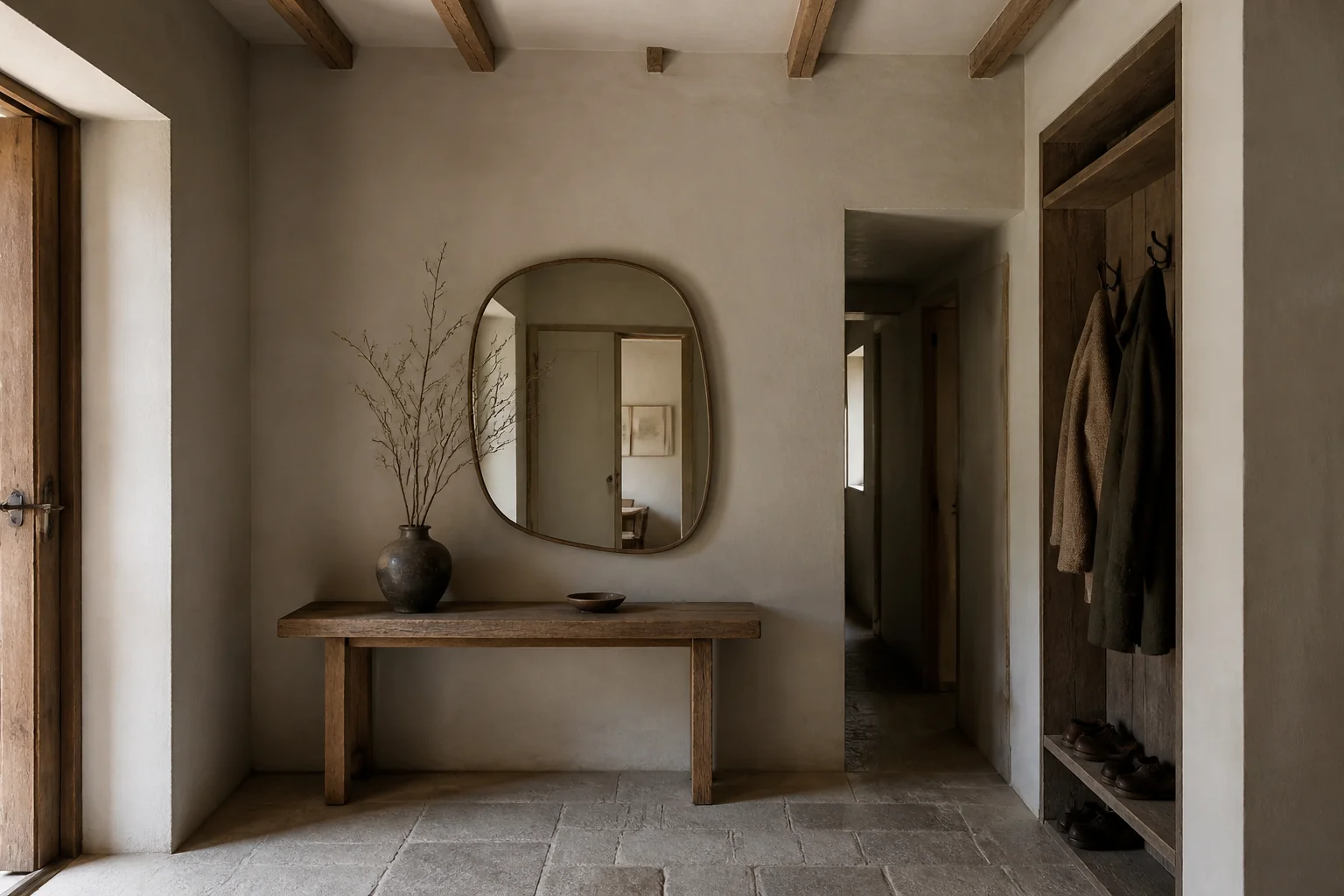
What the work actually covers
An entryway remodel is small and disproportionately visible. New flooring, a proper light, somewhere for keys and coats, and a wall treatment that says the house was thought about — done in a footprint most people walk through without stopping. Taken in Wabi-Sabi, the elements on the list — flooring at the threshold, console or bench, mirror, overhead light — are the ones carrying the look, and plaster and joinery finish. machine-perfect surfaces cancel the style whatever colours sit on them.
Making a entryway remodel read as Wabi-Sabi
Wabi-sabi resists the instinct of a remodel, which is to make everything new and level. The work is choosing materials that will age well and then not correcting them — lime plaster with movement, timber with grain, ceramic with variation. Against a entryway remodel that means the pieces doing the visible work are irregular ceramic vessels, low timber bench, linen-draped bed, sitting inside whatever the layout already demands.
Palette and materials
Wabi-Sabi holds a narrow range: Raw Plaster, Clay, Weathered Grey, Earth, Charcoal Wash, with materials running to textured lime plaster, hand-thrown ceramic, aged and knotted timber, raw linen. On a entryway remodel the discipline matters most wherever the largest uninterrupted surface is — keep that inside the range and every smaller decision gets easier.
Dimensions that do not move
A style choice never overrides the geometry. Whatever the finishes, the work still has to hold: Leave the full door swing plus 12in clear — an entry you have to step around is a permanent irritation. A console at 30–34in high and 12–14in deep fits without narrowing the route. Hang a mirror with its centre at 60in, opposite or adjacent to the light, never behind it.
Lighting
Low, warm and directional, so texture reads. Even flat light erases the entire point. One good fixture at the right height beats three mediocre ones. Hang a pendant with 7ft of clearance beneath it, and if the ceiling is low use a flush fixture with a diffuser rather than a shallow pendant that everyone taller than 6ft notices.
Where it usually goes wrong
The style breaks on symmetry, machine-perfect finishes, bright saturated colour. Independent of any style, this project is most often let down by a console deep enough to catch the door. a pendant hung at head height in a single-storey entry.
If the space is tight
Where there is no room for furniture, take the wall instead: a full-height panelled wall with a rail of hooks and a slim shelf gives an entry identity without occupying a single inch of floor. Plaster and joinery finish. Machine-perfect surfaces cancel the style whatever colours sit on them.
Questions
- Does Wabi-Sabi work for a small entryway?
- Where there is no room for furniture, take the wall instead: a full-height panelled wall with a rail of hooks and a slim shelf gives an entry identity without occupying a single inch of floor. Wabi-Sabi is helped by that, since imperfect surfaces, left as they are.
- Which surface matters most in a wabi-sabi entryway?
- Plaster and joinery finish. Machine-perfect surfaces cancel the style whatever colours sit on them.
- Can I see this on my own entryway?
- Yes. Upload a photo of the room and the Studio remodels it in Wabi-Sabi. New accounts get 4 credits and a Standard run costs 4, so there is a full render before anything is paid for.
- What ruins a wabi-sabi scheme?
- Usually symmetry and machine-perfect finishes.