Zen front porch remodel
Nothing on the surfaces, nothing raised in the room. What that means for a front porch remodel — what changes, the palette, the dimensions worth checking — and how to try it on a photo of your own room.
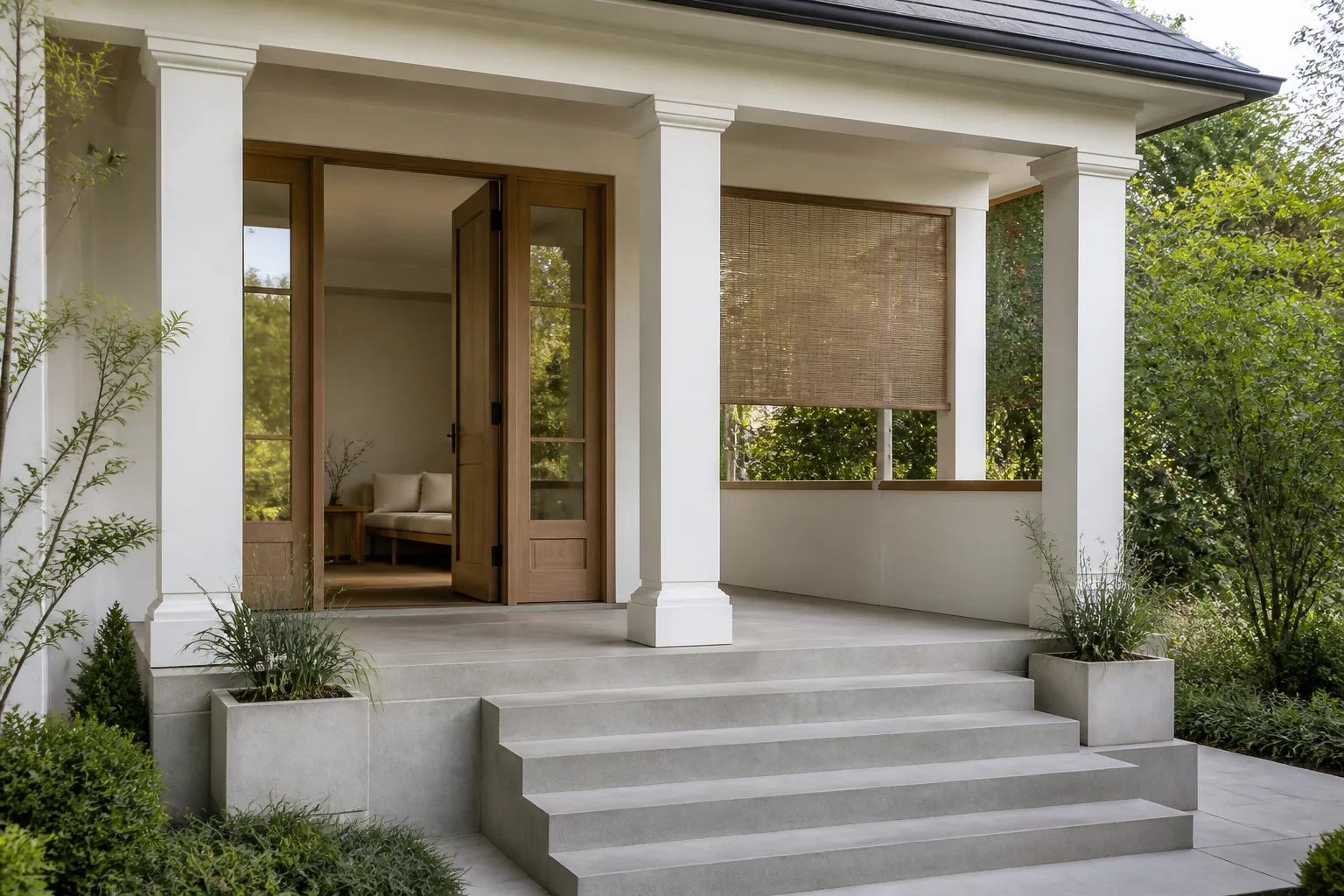
What the work actually covers
A front porch remodel is proportion and detail. Column thickness, rail height, ceiling material and the depth of the roof overhang decide whether a porch looks like it belongs to the house or like it was applied to the front of it. Taken in Zen, the elements on the list — columns and posts, balustrade, porch ceiling, decking or paving — are the ones carrying the look, and storage volume. every clear surface implies a cupboard somewhere, and the remodel has to build them.
Making a front porch remodel read as Zen
Zen is the most demanding remodel brief in this list, because the entire style is the absence of things. Concealed storage, level changes instead of furniture, a palette of two or three natural tones and daylight controlled with screens. Against a front porch remodel that means the pieces doing the visible work are low platform bed or floor cushions, shoji screen or sliding panel, low timber table, sitting inside whatever the layout already demands.
Palette and materials
Zen holds a narrow range: Paper White, Tatami, Stone Grey, Cedar, Sumi, with materials running to tatami and rush matting, shoji paper and timber lattice, cedar and hinoki, river stone. On a front porch remodel the discipline matters most wherever the largest uninterrupted surface is — keep that inside the range and every smaller decision gets easier.
Dimensions that do not move
A style choice never overrides the geometry. Whatever the finishes, the work still has to hold: A porch needs 6ft of depth to hold two chairs and still let people pass. Size columns to the roof they carry — a 4in post under a substantial roof always looks wrong. Keep the porch floor 1in below the interior threshold.
Lighting
Indirect and even, hidden entirely. Any visible fitting is an object, and objects are what this style removes. Two jobs, both modest: enough light on the door to find a keyhole, and enough on the steps to see them. A pair of flanking sconces at 66in does both. A single bright fixture overhead does neither well and lights the top of everyone's head.
Where it usually goes wrong
The style breaks on tall furniture, visible storage, applied pattern. Independent of any style, this project is most often let down by a porch too shallow to sit on, so it stays purely decorative. undersized columns under an oversized roof.
If the space is tight
If the porch is under 5ft deep, stop trying to furnish it. Spend the budget on the ceiling, the door surround and the lighting — a shallow porch done properly reads better than a shallow porch with a squeezed-in chair. Storage volume. Every clear surface implies a cupboard somewhere, and the remodel has to build them.
Questions
- Does Zen work for a small front porch?
- If the porch is under 5ft deep, stop trying to furnish it. Spend the budget on the ceiling, the door surround and the lighting — a shallow porch done properly reads better than a shallow porch with a squeezed-in chair. Zen is helped by that, since nothing on the surfaces, nothing raised in the room.
- Which surface matters most in a zen front porch?
- Storage volume. Every clear surface implies a cupboard somewhere, and the remodel has to build them.
- Can I see this on my own front porch?
- Yes. Upload a photo of the room and the Studio remodels it in Zen. New accounts get 4 credits and a Standard run costs 4, so there is a full render before anything is paid for.
- What ruins a zen scheme?
- Usually tall furniture and visible storage.