Art Deco kitchen remodel
Geometry, symmetry and materials chosen to catch light. What that means for a kitchen remodel — what changes, the palette, the dimensions worth checking — and how to try it on a photo of your own room.
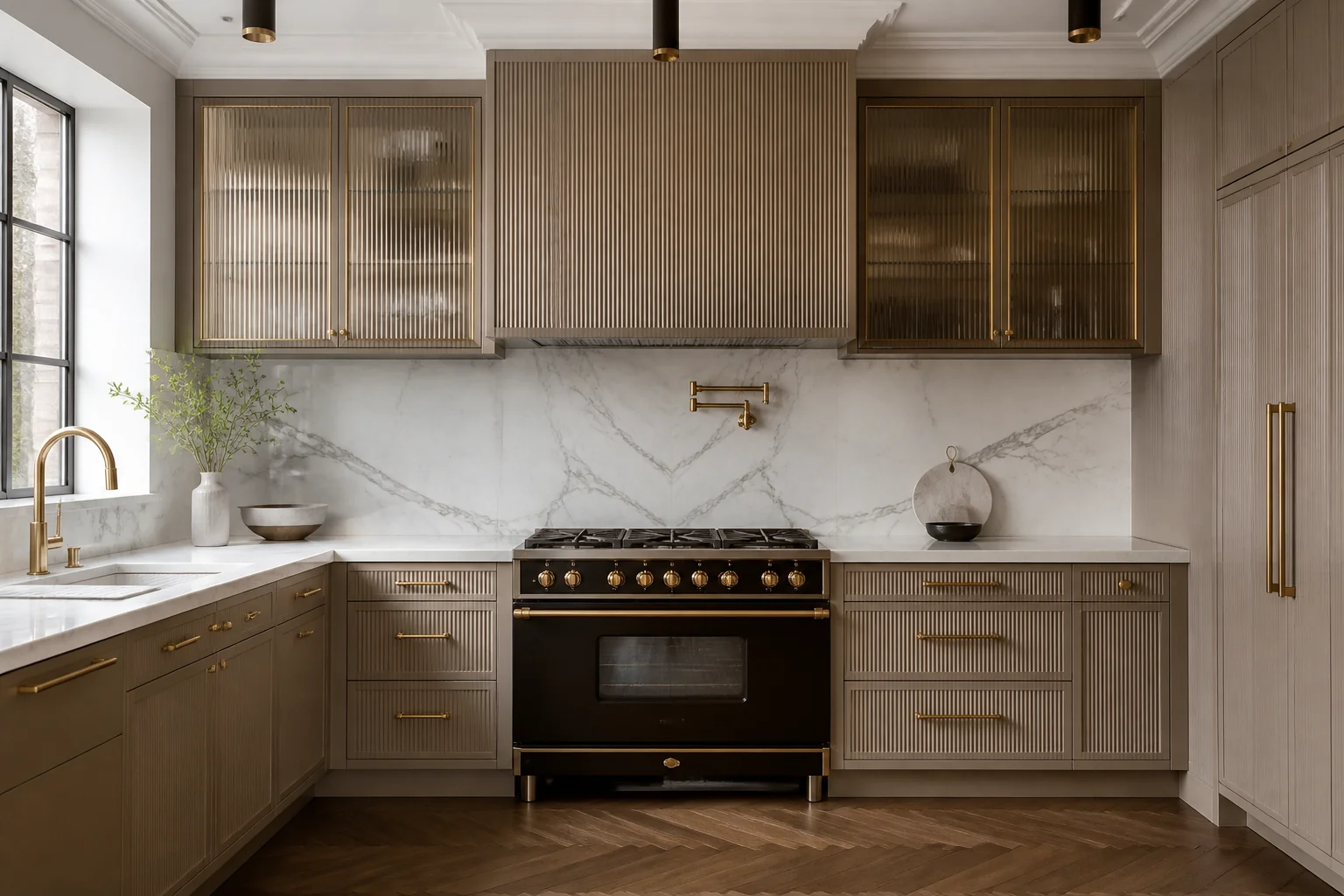
What the work actually covers
A kitchen remodel is really three decisions stacked on each other: where the sink, range and fridge sit, what the cabinets look like, and what the surfaces are made of. Move the first and the project doubles. Change only the last two and most kitchens still look completely different. Taken in Art Deco, the elements on the list — cabinet doors and boxes, countertops, backsplash, sink and tap — are the ones carrying the look, and joinery profiles and tile layout. fluting, stepped reveals and a laid pattern carry deco; paint colour alone never will.
Making a kitchen remodel read as Art Deco
Deco is the most architectural of the decorative styles: stepped forms, fluted panels, strong symmetry and a lot of polished surface. A remodel delivers it through joinery and tile rather than through furniture, which is why it survives in bathrooms better than anywhere else. Against a kitchen remodel that means the pieces doing the visible work are curved velvet sofa, fluted or stepped cabinet, sunburst mirror, sitting inside whatever the layout already demands.
Palette and materials
Art Deco holds a narrow range: Ivory Lacquer, Antique Brass, Oxblood, Peacock, Jet, with materials running to high-gloss lacquer, brass and chrome inlay, velvet, marble with dramatic veining. On a kitchen remodel the discipline matters most wherever the largest uninterrupted surface is — keep that inside the range and every smaller decision gets easier.
Dimensions that do not move
A style choice never overrides the geometry. Whatever the finishes, the work still has to hold: Keep the sink, range and fridge within a triangle whose sides total 13–26ft — tighter feels cramped, wider means walking. Leave 42in of clear floor in a one-cook kitchen and 48in where two people work. Allow at least 15in of landing space beside the fridge on the handle side.
Lighting
Fixtures as jewellery — frosted glass, brass, tiered shades. Symmetrically placed, always in pairs. Under-cabinet strips first — they do the actual work and no ceiling fixture replaces them. Then a general layer on dimmers, and pendants over an island sized so they clear sightlines at 30–36in above the counter.
Where it usually goes wrong
The style breaks on rustic or distressed finishes, asymmetric arrangements, mixing more than two metals. Independent of any style, this project is most often let down by new cabinets in the same bad layout, so the kitchen looks fixed and still works badly. a backsplash chosen against a countertop sample rather than the actual slab.
If the space is tight
In a galley under 8ft wide, run cabinets to the ceiling on one side only and keep the opposite run open. Two facing walls of upper cabinets is what makes a narrow kitchen feel like a corridor. Joinery profiles and tile layout. Fluting, stepped reveals and a laid pattern carry Deco; paint colour alone never will.
Questions
- Does Art Deco work for a small kitchen?
- In a galley under 8ft wide, run cabinets to the ceiling on one side only and keep the opposite run open. Two facing walls of upper cabinets is what makes a narrow kitchen feel like a corridor. Art Deco is helped by that, since geometry, symmetry and materials chosen to catch light.
- Which surface matters most in a art deco kitchen?
- Joinery profiles and tile layout. Fluting, stepped reveals and a laid pattern carry Deco; paint colour alone never will.
- Can I see this on my own kitchen?
- Yes. Upload a photo of the room and the Studio remodels it in Art Deco. New accounts get 4 credits and a Standard run costs 4, so there is a full render before anything is paid for.
- What ruins a art deco scheme?
- Usually rustic or distressed finishes and asymmetric arrangements.