Japandi fireplace remodel
Japanese restraint with Nordic warmth, each keeping the other honest. What that means for a fireplace remodel — what changes, the palette, the dimensions worth checking — and how to try it on a photo of your own room.
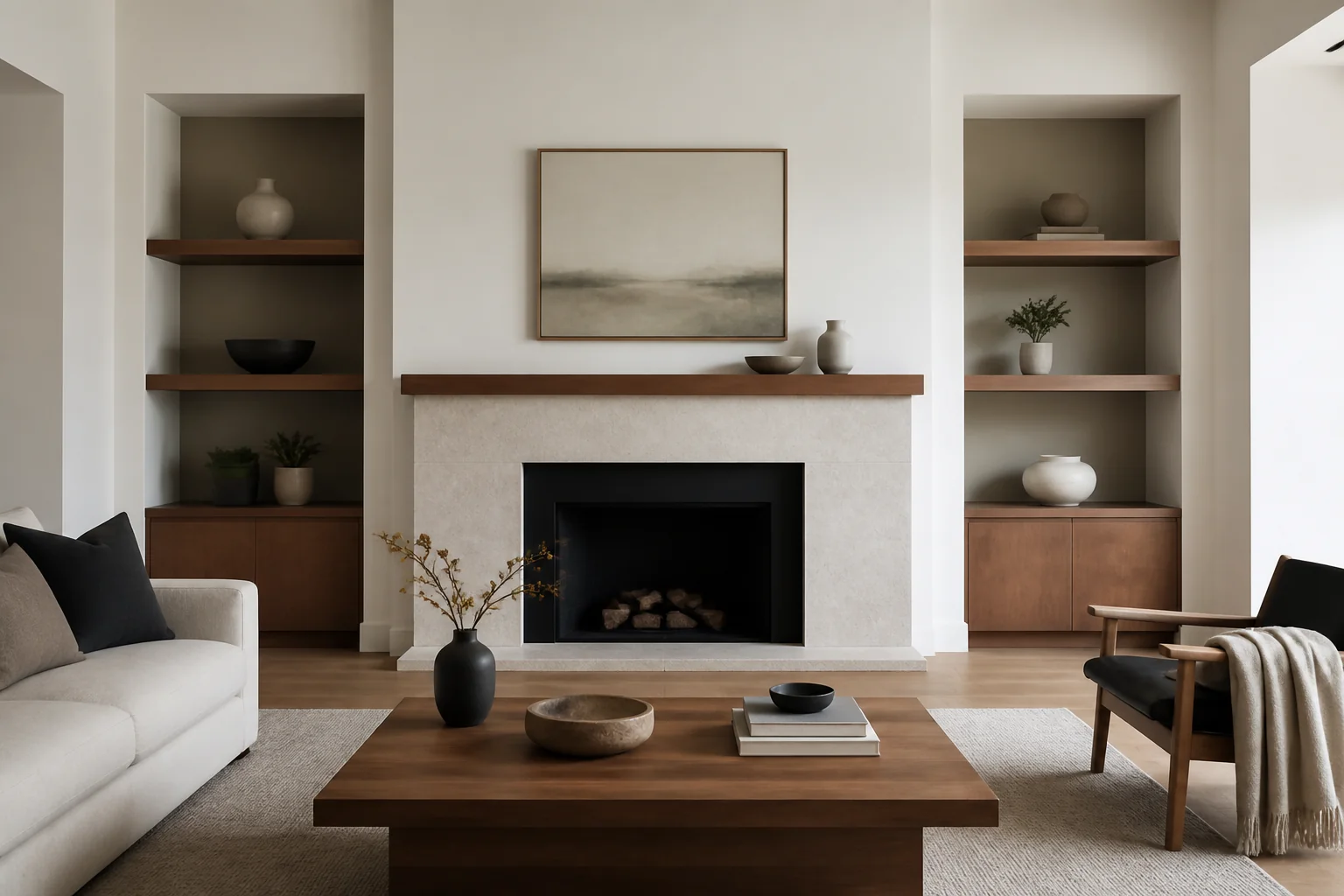
What the work actually covers
A fireplace remodel is surround, hearth and mantel — and, increasingly, undoing a television mounted above it. The firebox usually stays; what changes is the material facing it, its proportions, and whether the chimney breast keeps its alcoves or loses them. Taken in Japandi, the elements on the list — surround material, hearth, mantel and shelf, chimney breast profile — are the ones carrying the look, and storage. japandi is a promise about empty surfaces, so the remodel has to provide somewhere for everything to go out of sight.
Making a fireplace remodel read as Japandi
Japandi asks for empty surfaces, low horizontals and a palette that stays inside five tones. In a remodel it is unusually demanding, because clear counters and hidden storage have to be built in rather than tidied into place. Against a fireplace remodel that means the pieces doing the visible work are low platform bed or sofa, slatted timber screen, handthrown ceramic vessels, sitting inside whatever the layout already demands.
Palette and materials
Japandi holds a narrow range: Rice Paper, Raw Linen, Clay Grey, Charred Oak, Sumi Ink, with materials running to white oak, blackened timber, handmade ceramic, raw linen. On a fireplace remodel the discipline matters most wherever the largest uninterrupted surface is — keep that inside the range and every smaller decision gets easier.
Dimensions that do not move
A style choice never overrides the geometry. Whatever the finishes, the work still has to hold: Leave 16in of clear hearth in front and 8in to each side of the opening. A mantel sits at 54in for a standard opening; higher and the room stretches, lower and it crowds the fire. Keep alcove joinery to 18in deep — beyond that it projects past the chimney breast and reads as lumpy.
Lighting
Diffused through paper or fabric, concealed where possible. Hard shadows are the thing this style is arranged to avoid. Let the fire be the brightest thing in its half of the room. Wash the chimney breast with something low and warm so the material reads after dark, put picture lights on anything hung above, and keep downlights off the surround — they flatten stone and make tile look like a bathroom.
Where it usually goes wrong
The style breaks on visible clutter, high-gloss finishes, cool blue-white bulbs. Independent of any style, this project is most often let down by a television mounted above the fire, too high to watch and too hot to be there. a surround material chosen from a sample rather than seen at full height.
If the space is tight
In a small room, taking the surround material to the ceiling makes the wall taller rather than busier — a mantel with a gap of blank wall above it does the opposite and cuts the height in half. Storage. Japandi is a promise about empty surfaces, so the remodel has to provide somewhere for everything to go out of sight.
Questions
- Does Japandi work for a small fireplace?
- In a small room, taking the surround material to the ceiling makes the wall taller rather than busier — a mantel with a gap of blank wall above it does the opposite and cuts the height in half. Japandi is helped by that, since japanese restraint with nordic warmth, each keeping the other honest.
- Which surface matters most in a japandi fireplace?
- Storage. Japandi is a promise about empty surfaces, so the remodel has to provide somewhere for everything to go out of sight.
- Can I see this on my own fireplace?
- Yes. Upload a photo of the room and the Studio remodels it in Japandi. New accounts get 4 credits and a Standard run costs 4, so there is a full render before anything is paid for.
- What ruins a japandi scheme?
- Usually visible clutter and high-gloss finishes.