Southwestern staircase remodel
Adobe warmth, woven texture and a desert palette. What that means for a staircase remodel — what changes, the palette, the dimensions worth checking — and how to try it on a photo of your own room.
What the work actually covers
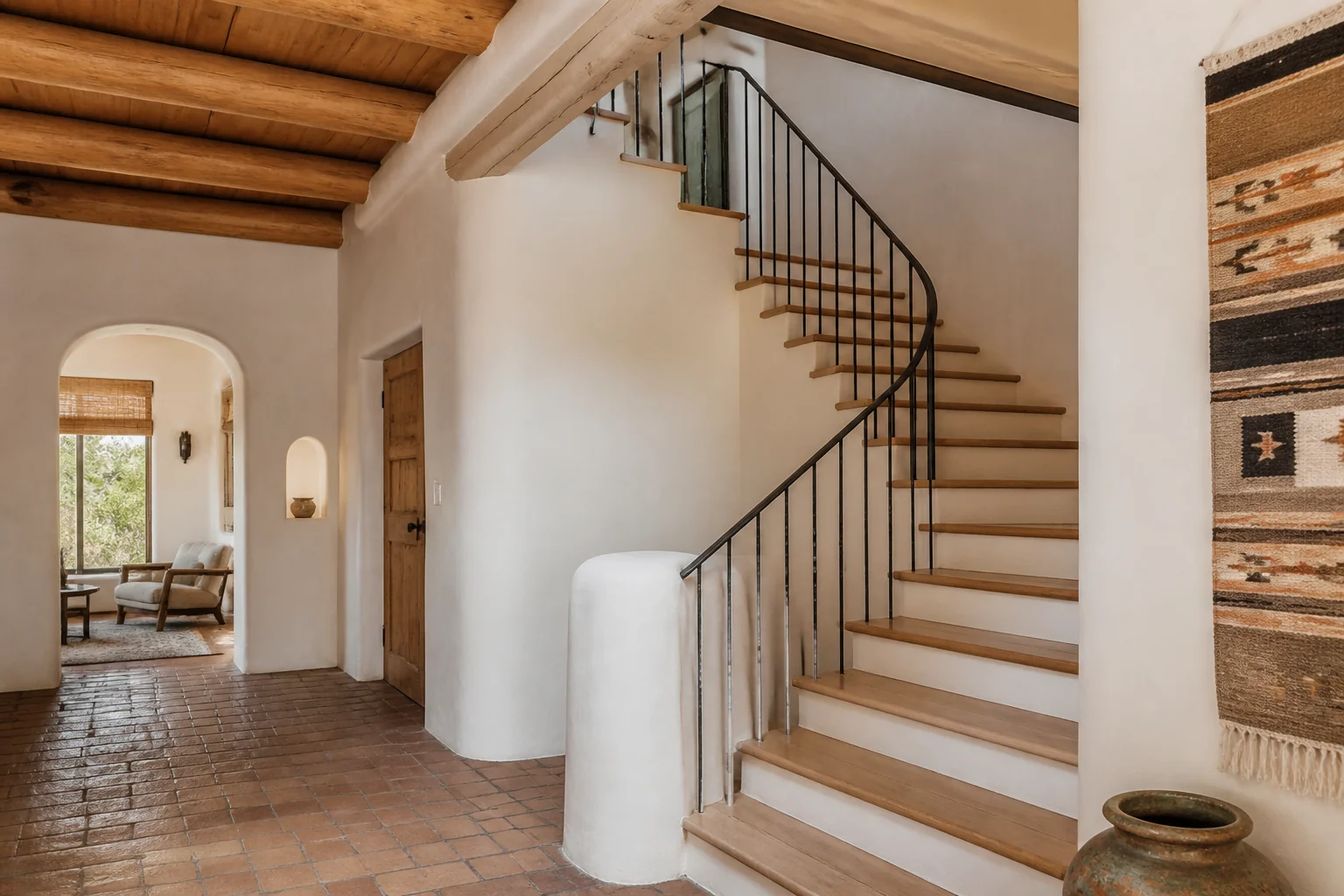
A staircase remodel is usually cosmetic — treads, balustrade, handrail, the wall alongside — and it changes the hall more than new flooring would. The geometry stays; what changes is whether the stair looks like part of the house or like something the house came with. Taken in Southwestern, the elements on the list — treads and risers, balustrade and spindles, handrail, newel posts — are the ones carrying the look, and corners and openings. rounded arrises and shaped niches carry the style; the textiles are the finish.
Making a staircase remodel read as Southwestern
Southwestern is rounded plaster forms, exposed timber vigas, saltillo tile and woven textiles in a clay palette. The remodel is largely about softening edges — square corners are what makes an adobe-inspired room read wrong. Against a staircase remodel that means the pieces doing the visible work are viga beam ceiling, woven wool rug, leather butaque chair, sitting inside whatever the layout already demands.
Palette and materials
Southwestern holds a narrow range: Adobe White, Sand, Clay, Turquoise, Mesquite, with materials running to adobe and lime plaster, saltillo tile, woven wool, leather. On a staircase remodel the discipline matters most wherever the largest uninterrupted surface is — keep that inside the range and every smaller decision gets easier.
Dimensions that do not move
A style choice never overrides the geometry. Whatever the finishes, the work still has to hold: Handrail height sits at 34–38in above the pitch line, and must be graspable — a wide flat rail is not. Keep balusters under 4in apart. A runner should leave 3–4in of tread visible on each side, equally.
Lighting
Warm and low, from mica, iron and ceramic shades. Shadow is part of the effect. Light the treads, not the stairwell. Wall lights at low level or recessed step lights make the geometry readable; a single pendant hung in the void looks impressive and leaves the steps in shadow.
Where it usually goes wrong
The style breaks on cool colour schemes, glossy finishes, sleek modern furniture. Independent of any style, this project is most often let down by a pendant in the stairwell that nobody can reach to clean or relamp. new spindles fitted to old newels, so the two never match.
If the space is tight
Replacing a solid balustrade with open spindles or glass is the single biggest visual gain in a narrow hall — it lets the eye through to the wall beyond and the stair stops dividing the space. Corners and openings. Rounded arrises and shaped niches carry the style; the textiles are the finish.
Questions
- Does Southwestern work for a small staircase?
- Replacing a solid balustrade with open spindles or glass is the single biggest visual gain in a narrow hall — it lets the eye through to the wall beyond and the stair stops dividing the space. Southwestern is helped by that, since adobe warmth, woven texture and a desert palette.
- Which surface matters most in a southwestern staircase?
- Corners and openings. Rounded arrises and shaped niches carry the style; the textiles are the finish.
- Can I see this on my own staircase?
- Yes. Upload a photo of the room and the Studio remodels it in Southwestern. New accounts get 4 credits and a Standard run costs 4, so there is a full render before anything is paid for.
- What ruins a southwestern scheme?
- Usually cool colour schemes and glossy finishes.