Wabi-Sabi living room remodel
Imperfect surfaces, left as they are. What that means for a living room remodel — what changes, the palette, the dimensions worth checking — and how to try it on a photo of your own room.
What the work actually covers
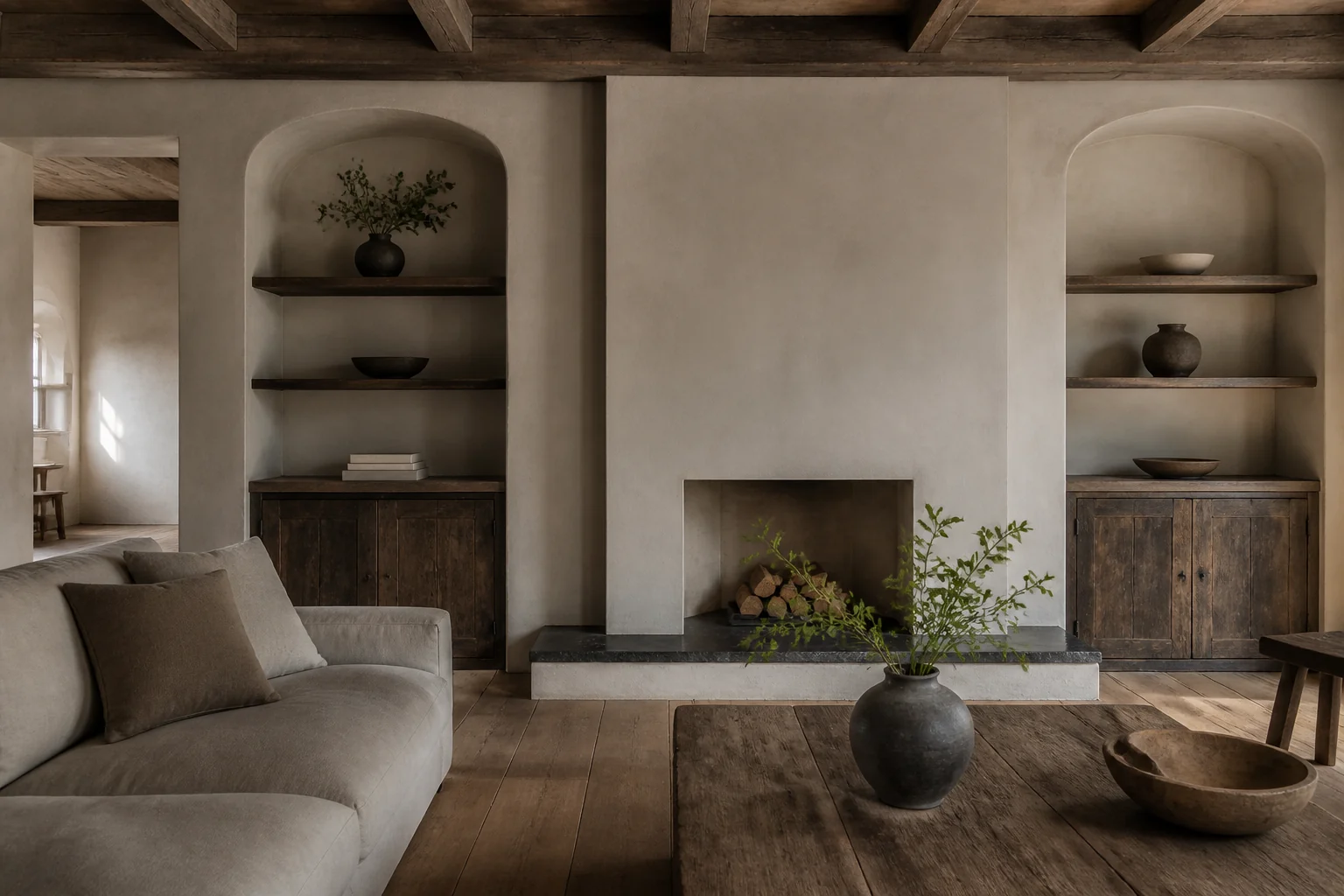
Living rooms are remodelled for three reasons: the fireplace is dated, the floor is tired, or the lighting is a single fitting in the middle of the ceiling. Address those and the furniture arrangement usually sorts itself out, because it was the room fighting back, not the sofa. Taken in Wabi-Sabi, the elements on the list — fireplace and surround, flooring, lighting and switching, built-in joinery — are the ones carrying the look, and plaster and joinery finish. machine-perfect surfaces cancel the style whatever colours sit on them.
Making a living room remodel read as Wabi-Sabi
Wabi-sabi resists the instinct of a remodel, which is to make everything new and level. The work is choosing materials that will age well and then not correcting them — lime plaster with movement, timber with grain, ceramic with variation. Against a living room remodel that means the pieces doing the visible work are irregular ceramic vessels, low timber bench, linen-draped bed, sitting inside whatever the layout already demands.
Palette and materials
Wabi-Sabi holds a narrow range: Raw Plaster, Clay, Weathered Grey, Earth, Charcoal Wash, with materials running to textured lime plaster, hand-thrown ceramic, aged and knotted timber, raw linen. On a living room remodel the discipline matters most wherever the largest uninterrupted surface is — keep that inside the range and every smaller decision gets easier.
Dimensions that do not move
A style choice never overrides the geometry. Whatever the finishes, the work still has to hold: Keep seating within 8ft of each other or the room stops holding a conversation. Build joinery to 18in deep flanking a chimney breast — deeper and it projects past the breast awkwardly. Leave a 32in route through the room that does not pass between the seating and the fire.
Lighting
Low, warm and directional, so texture reads. Even flat light erases the entire point. The single most common living room fault is one central pendant. Replace it with four or five low-output sources at different heights — a floor lamp by each seat, a picture light, something on a shelf — and put the lot on one dimmed circuit.
Where it usually goes wrong
The style breaks on symmetry, machine-perfect finishes, bright saturated colour. Independent of any style, this project is most often let down by a television mounted above the fire, too high to watch comfortably. joinery built deeper than the chimney breast so the wall reads as lumpy.
If the space is tight
Removing a chimney breast is the one structural move that reliably transforms a small living room, because it returns two alcoves' worth of wall and lets furniture sit flat. It is also the one people regret skipping. Plaster and joinery finish. Machine-perfect surfaces cancel the style whatever colours sit on them.
Questions
- Does Wabi-Sabi work for a small living room?
- Removing a chimney breast is the one structural move that reliably transforms a small living room, because it returns two alcoves' worth of wall and lets furniture sit flat. It is also the one people regret skipping. Wabi-Sabi is helped by that, since imperfect surfaces, left as they are.
- Which surface matters most in a wabi-sabi living room?
- Plaster and joinery finish. Machine-perfect surfaces cancel the style whatever colours sit on them.
- Can I see this on my own living room?
- Yes. Upload a photo of the room and the Studio remodels it in Wabi-Sabi. New accounts get 4 credits and a Standard run costs 4, so there is a full render before anything is paid for.
- What ruins a wabi-sabi scheme?
- Usually symmetry and machine-perfect finishes.