Tropical dining room remodel
Rattan, palm and ceiling fans, kept light rather than themed. What that means for a dining room remodel — what changes, the palette, the dimensions worth checking — and how to try it on a photo of your own room.
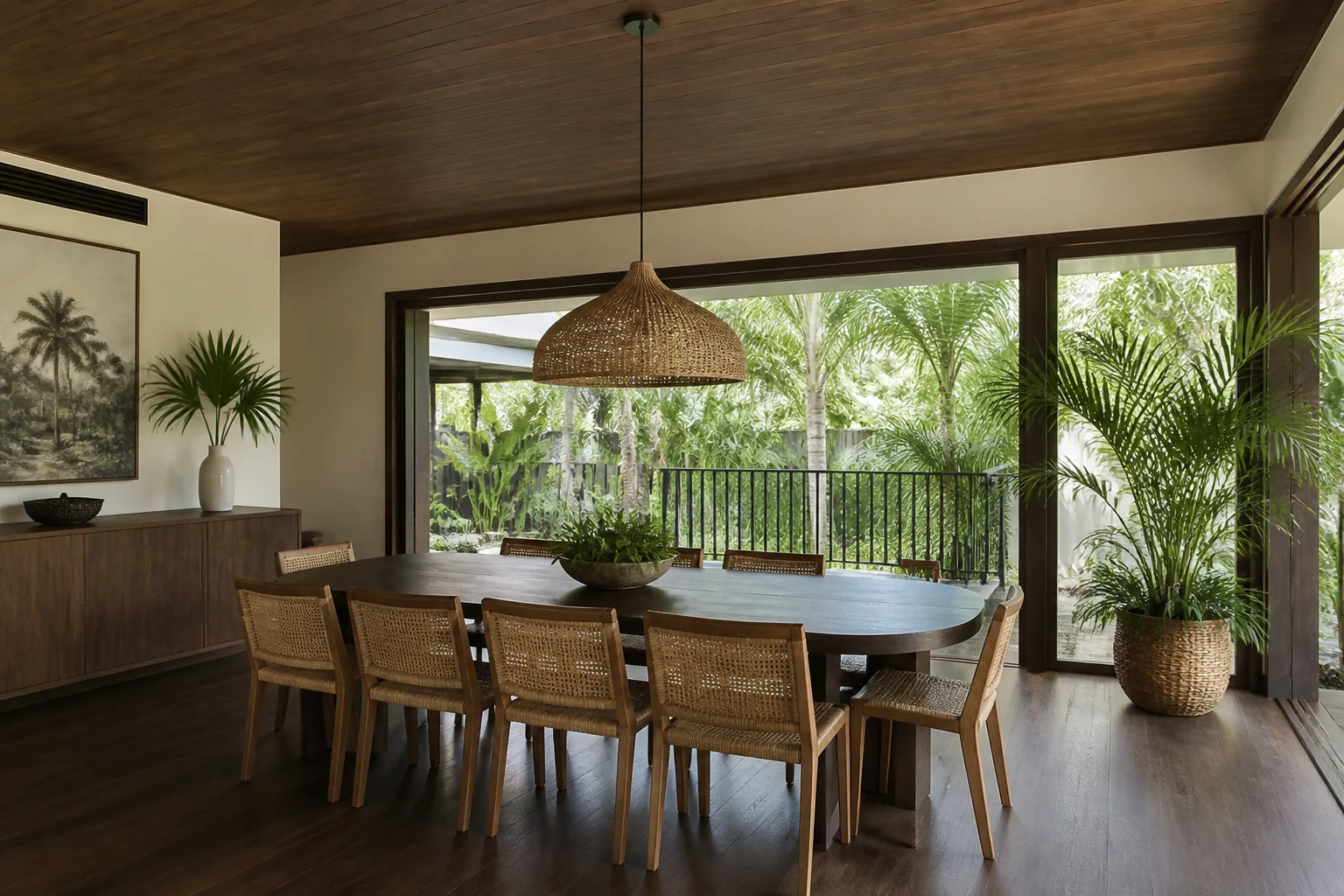
What the work actually covers
A dining room remodel is mostly about the perimeter. The table position is fixed by the room, so the work goes into what surrounds it — panelling, storage, the light above it, and often removing the wall that separated it from the kitchen in the first place. Taken in Tropical, the elements on the list — wall panelling or paper, pendant over the table, built-in sideboard, flooring — are the ones carrying the look, and ceiling. boarded or panelled ceilings with a fan are what set it, more than any textile.
Making a dining room remodel read as Tropical
Tropical interiors are pale shells with dark timber accents, natural fibre and a lot of planting. The remodel risk is theming — once the prints appear the room stops being tropical and starts being a bar. Against a dining room remodel that means the pieces doing the visible work are rattan lounge chair, ceiling fan with timber blades, louvred shutters, sitting inside whatever the layout already demands.
Palette and materials
Tropical holds a narrow range: Coconut, Rattan, Palm, Lagoon, Hibiscus, with materials running to rattan and bamboo, teak, louvred timber shutters, sisal. On a dining room remodel the discipline matters most wherever the largest uninterrupted surface is — keep that inside the range and every smaller decision gets easier.
Dimensions that do not move
A style choice never overrides the geometry. Whatever the finishes, the work still has to hold: Allow 36in from the table edge to the wall; 42in where people pass behind seated diners. Hang the pendant 30–34in above the table top, centred on the table rather than the room. Size the pendant to roughly half the table width — smaller looks lost, larger blocks sightlines.
Lighting
Warm and low, with fans doing visual work as much as functional. The pendant is the room. Everything else is support: a couple of wall lights or a lamp on the sideboard so the room is not a pool of light with dark edges. Dimmers are non-negotiable here more than anywhere.
Where it usually goes wrong
The style breaks on heavy upholstery, dark enclosed rooms, wall-to-wall carpet. Independent of any style, this project is most often let down by a pendant centred on the room instead of the table, once the table moved. chairs that cannot pull out because the sideboard is opposite.
If the space is tight
A round table seats the same number in less floor and removes the corners people cannot use. In a room under 10×10ft it is the difference between a dining room and a room with a table in it. Ceiling. Boarded or panelled ceilings with a fan are what set it, more than any textile.
Questions
- Does Tropical work for a small dining room?
- A round table seats the same number in less floor and removes the corners people cannot use. In a room under 10×10ft it is the difference between a dining room and a room with a table in it. Tropical is helped by that, since rattan, palm and ceiling fans, kept light rather than themed.
- Which surface matters most in a tropical dining room?
- Ceiling. Boarded or panelled ceilings with a fan are what set it, more than any textile.
- Can I see this on my own dining room?
- Yes. Upload a photo of the room and the Studio remodels it in Tropical. New accounts get 4 credits and a Standard run costs 4, so there is a full render before anything is paid for.
- What ruins a tropical scheme?
- Usually heavy upholstery and dark enclosed rooms.