Coastal nursery remodel
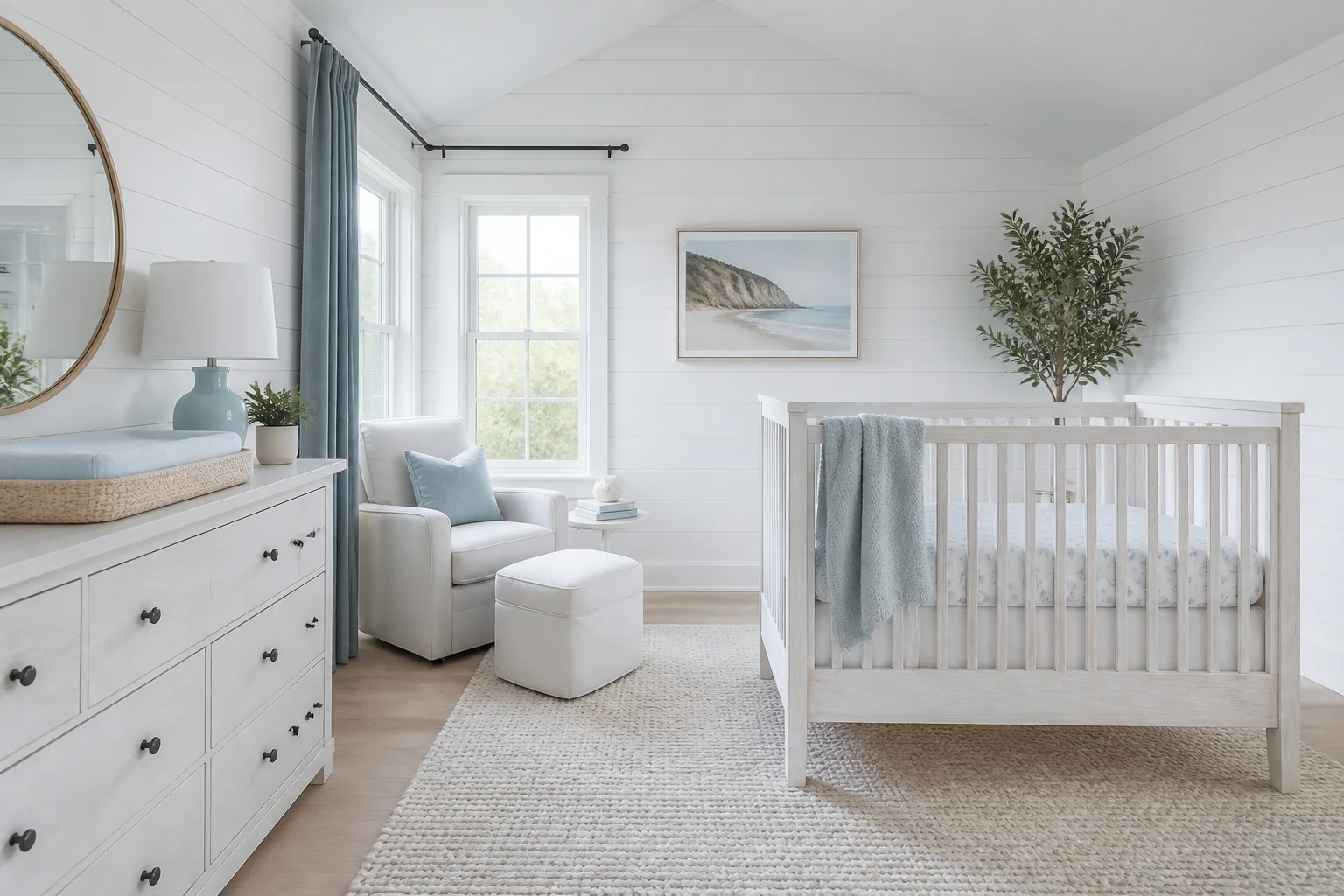
Light woods, white walls and blue used sparingly enough to mean something. What that means for a nursery remodel — what changes, the palette, the dimensions worth checking — and how to try it on a photo of your own room.
What the work actually covers
A nursery remodel is short-lived unless it is planned to change. The crib wall becomes a bed wall, the changing table becomes a chest of drawers, and the storage that held muslins holds toys. The work is choosing pieces and dimensions that survive that transition. Taken in Coastal, the elements on the list — crib and changing area, storage and drawers, nursing chair corner, blackout treatment — are the ones carrying the look, and window treatment. coastal fails the moment the windows are dressed heavily, whatever the walls are doing.
Making a nursery remodel read as Coastal
Coastal is a light problem before it is a colour problem. Pale floors, white or near-white walls, and natural fibre underfoot — with blue kept to accents, because a blue room reads as a theme rather than a coast. Against a nursery remodel that means the pieces doing the visible work are slipcovered sofa, woven natural-fibre rug, rattan accent chair, sitting inside whatever the layout already demands.
Palette and materials
Coastal holds a narrow range: Sailcloth, Driftwood, Sea Glass, Harbour Blue, Deep Tide, with materials running to whitewashed oak, linen slipcovers, jute and sisal, rattan. On a nursery remodel the discipline matters most wherever the largest uninterrupted surface is — keep that inside the range and every smaller decision gets easier.
Dimensions that do not move
A style choice never overrides the geometry. Whatever the finishes, the work still has to hold: Keep the crib away from the window, off the radiator wall, and clear of any cord. A changing surface sits at 36in with 24in of clear counter beside it. Leave 30in beside the nursing chair for a side table within reach.
Lighting
Cool-leaning daylight preserved, and warm artificial light after dark. Sheer window treatments rather than heavy ones. Everything dimmable and nothing overhead above the crib. A very low warm setting for night feeds, a lamp beside the chair, and one brighter layer for the daytime — with the switch reachable while holding a baby.
Where it usually goes wrong
The style breaks on nautical novelty — anchors, ship wheels, rope knots as decor, navy used too heavily, heavy dark drapery. Independent of any style, this project is most often let down by a dedicated changing table that is furniture-shaped landfill within two years. the crib under a window, in the draught and the morning light.
If the space is tight
Skip the changing table and put a changing mat on a normal dresser. It saves a metre of wall in a small room and removes the one piece guaranteed to be obsolete first. Window treatment. Coastal fails the moment the windows are dressed heavily, whatever the walls are doing.
Questions
- Does Coastal work for a small nursery?
- Skip the changing table and put a changing mat on a normal dresser. It saves a metre of wall in a small room and removes the one piece guaranteed to be obsolete first. Coastal is helped by that, since light woods, white walls and blue used sparingly enough to mean something.
- Which surface matters most in a coastal nursery?
- Window treatment. Coastal fails the moment the windows are dressed heavily, whatever the walls are doing.
- Can I see this on my own nursery?
- Yes. Upload a photo of the room and the Studio remodels it in Coastal. New accounts get 4 credits and a Standard run costs 4, so there is a full render before anything is paid for.
- What ruins a coastal scheme?
- Usually nautical novelty — anchors, ship wheels, rope knots as decor and navy used too heavily.