Scandinavian nursery remodel
Pale timber, white walls, and daylight treated as the main material. What that means for a nursery remodel — what changes, the palette, the dimensions worth checking — and how to try it on a photo of your own room.
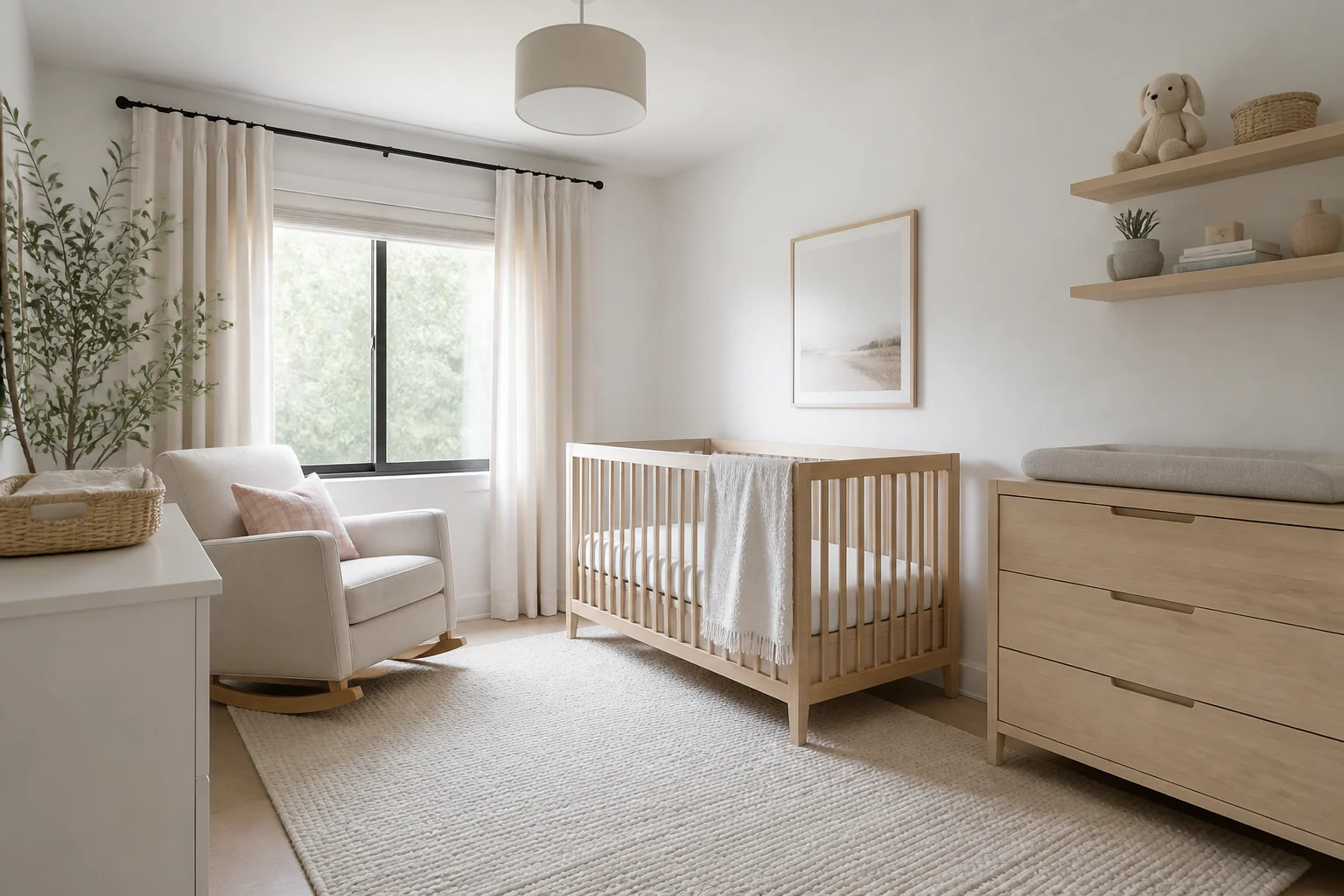
What the work actually covers
A nursery remodel is short-lived unless it is planned to change. The crib wall becomes a bed wall, the changing table becomes a chest of drawers, and the storage that held muslins holds toys. The work is choosing pieces and dimensions that survive that transition. Taken in Scandinavian, the elements on the list — crib and changing area, storage and drawers, nursing chair corner, blackout treatment — are the ones carrying the look, and the floor. nothing changes a room toward scandinavian faster than pale oak underfoot, and nothing undoes it faster than a dark one.
Making a nursery remodel read as Scandinavian
A Scandinavian remodel is mostly about removing what absorbs light: dark floors, heavy trim, deep cabinetry. Pale oak, white walls and a low-contrast palette let a room feel bright even in a north-facing house. Against a nursery remodel that means the pieces doing the visible work are light oak dining table with slim legs, sofa in pale wool or bouclé, open low shelving, sitting inside whatever the layout already demands.
Palette and materials
Scandinavian holds a narrow range: Snow, Birch, Oat, Stone Grey, Charcoal, with materials running to blond oak and birch, undyed wool, washed linen, matte white paint. On a nursery remodel the discipline matters most wherever the largest uninterrupted surface is — keep that inside the range and every smaller decision gets easier.
Dimensions that do not move
A style choice never overrides the geometry. Whatever the finishes, the work still has to hold: Keep the crib away from the window, off the radiator wall, and clear of any cord. A changing surface sits at 36in with 24in of clear counter beside it. Leave 30in beside the nursing chair for a side table within reach.
Lighting
Many small warm sources rather than one bright one. Nordic interiors are lit at table height, not from the ceiling. Everything dimmable and nothing overhead above the crib. A very low warm setting for night feeds, a lamp beside the chair, and one brighter layer for the daytime — with the switch reachable while holding a baby.
Where it usually goes wrong
The style breaks on dark heavy woods, overhead fluorescent light, glossy black surfaces. Independent of any style, this project is most often let down by a dedicated changing table that is furniture-shaped landfill within two years. the crib under a window, in the draught and the morning light.
If the space is tight
Skip the changing table and put a changing mat on a normal dresser. It saves a metre of wall in a small room and removes the one piece guaranteed to be obsolete first. The floor. Nothing changes a room toward Scandinavian faster than pale oak underfoot, and nothing undoes it faster than a dark one.
Questions
- Does Scandinavian work for a small nursery?
- Skip the changing table and put a changing mat on a normal dresser. It saves a metre of wall in a small room and removes the one piece guaranteed to be obsolete first. Scandinavian is helped by that, since pale timber, white walls, and daylight treated as the main material.
- Which surface matters most in a scandinavian nursery?
- The floor. Nothing changes a room toward Scandinavian faster than pale oak underfoot, and nothing undoes it faster than a dark one.
- Can I see this on my own nursery?
- Yes. Upload a photo of the room and the Studio remodels it in Scandinavian. New accounts get 4 credits and a Standard run costs 4, so there is a full render before anything is paid for.
- What ruins a scandinavian scheme?
- Usually dark heavy woods and overhead fluorescent light.