Industrial primary bedroom remodel
Structure left visible, because it was worth looking at. What that means for a primary bedroom remodel — what changes, the palette, the dimensions worth checking — and how to try it on a photo of your own room.
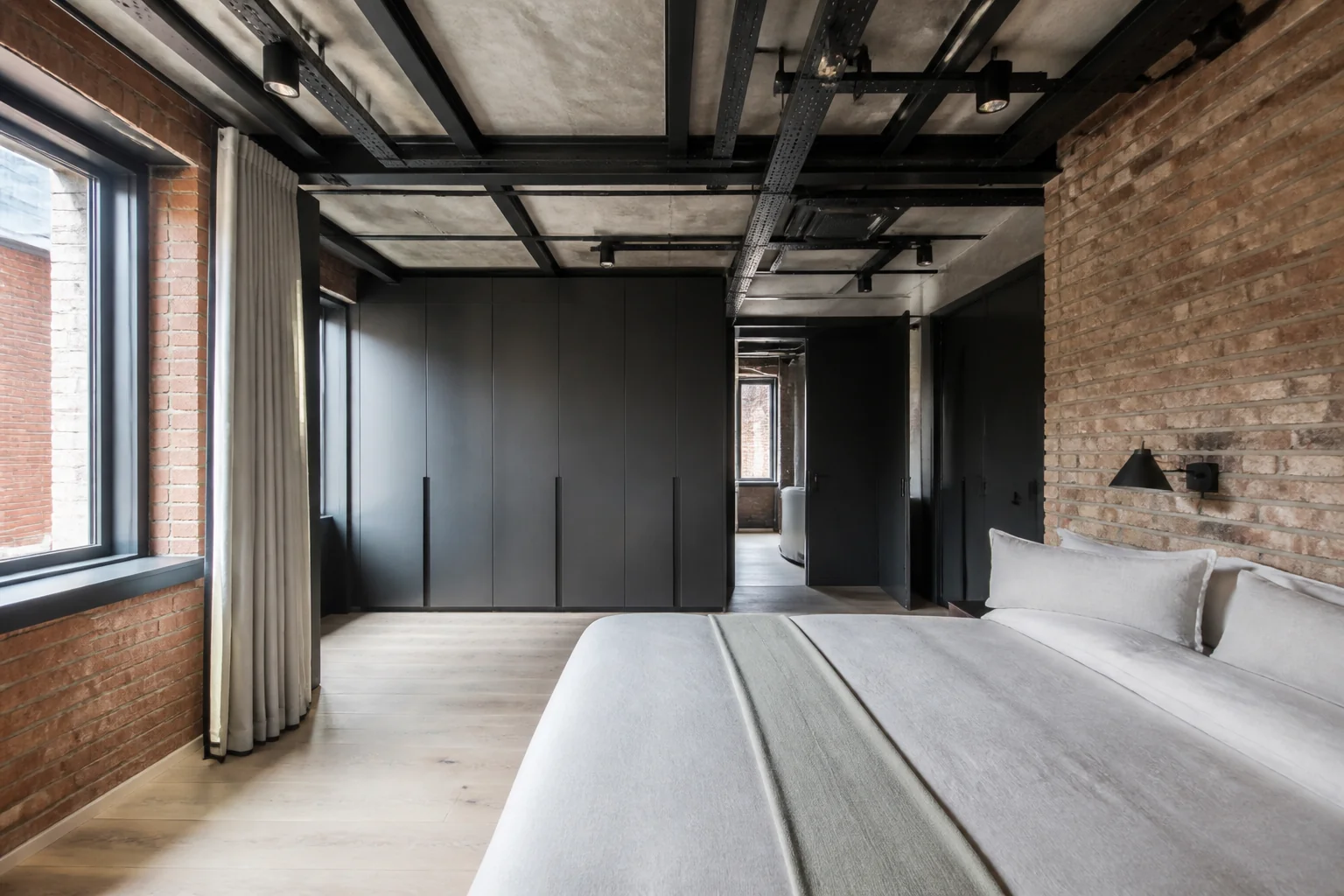
What the work actually covers
A primary bedroom remodel works around a bed that cannot move much and cannot shrink. What changes is everything around it: where the storage goes, how the light works at both ends of the day, and whether the room still has floor left once the wardrobes are in. Taken in Industrial, the elements on the list — built-in wardrobes, wall finishes, flooring, lighting and switching — are the ones carrying the look, and the ceiling. painted joists, exposed ductwork and surface conduit are what make a room read industrial, and a plasterboard ceiling ends the conversation.
Making a primary bedroom remodel read as Industrial
Industrial keeps the bones on show: brick, steel, concrete, services running openly across the ceiling. In a remodel it inverts the usual instinct — the work is deciding what not to cover, then finishing the exposed elements properly so they read as chosen. Against a primary bedroom remodel that means the pieces doing the visible work are steel-and-timber shelving, leather chesterfield or club chair, factory pendant lights, sitting inside whatever the layout already demands.
Palette and materials
Industrial holds a narrow range: Cement, Weathered Brick, Oxidised Steel, Saddle Leather, Iron, with materials running to exposed brick, blackened steel, reclaimed timber, polished concrete. On a primary bedroom remodel the discipline matters most wherever the largest uninterrupted surface is — keep that inside the range and every smaller decision gets easier.
Dimensions that do not move
A style choice never overrides the geometry. Whatever the finishes, the work still has to hold: Leave 30in of clear floor on both sides of a double bed and 36in at the foot if there is a route past. Hinged wardrobe doors need 24in of swing; sliders need none, which is usually the deciding factor. Centre the bed on a wall with no door and no window if the room offers one — the headboard wall should be uninterrupted.
Lighting
Metal shades and visible filaments, hung low over the surfaces that matter. Bare fittings suit the style; bare bulbs at ceiling height do not. Two switching positions, door and bedside, or the room fails at the only moment that matters. Ambient on a dimmer, a reading light per side aimed at the page rather than the room, and nothing overhead directly above the pillows.
Where it usually goes wrong
The style breaks on wall-to-wall carpet, fussy soft furnishings, painted-over brick in a room already short on warmth. Independent of any style, this project is most often let down by wardrobes along the only wall that could have taken the bed. a single ceiling light switched only at the door.
If the space is tight
Under 11×11ft, wall-mounted reading lights and floating bedside shelves buy back the floor that lamps and tables take. The bed can also lose its frame — a low platform makes a small bedroom read taller. The ceiling. Painted joists, exposed ductwork and surface conduit are what make a room read industrial, and a plasterboard ceiling ends the conversation.
Questions
- Does Industrial work for a small primary bedroom?
- Under 11×11ft, wall-mounted reading lights and floating bedside shelves buy back the floor that lamps and tables take. The bed can also lose its frame — a low platform makes a small bedroom read taller. Industrial is helped by that, since structure left visible, because it was worth looking at.
- Which surface matters most in a industrial primary bedroom?
- The ceiling. Painted joists, exposed ductwork and surface conduit are what make a room read industrial, and a plasterboard ceiling ends the conversation.
- Can I see this on my own primary bedroom?
- Yes. Upload a photo of the room and the Studio remodels it in Industrial. New accounts get 4 credits and a Standard run costs 4, so there is a full render before anything is paid for.
- What ruins a industrial scheme?
- Usually wall-to-wall carpet and fussy soft furnishings.