Japandi outdoor kitchen remodel
Japanese restraint with Nordic warmth, each keeping the other honest. What that means for a outdoor kitchen remodel — what changes, the palette, the dimensions worth checking — and how to try it on a photo of your own room.
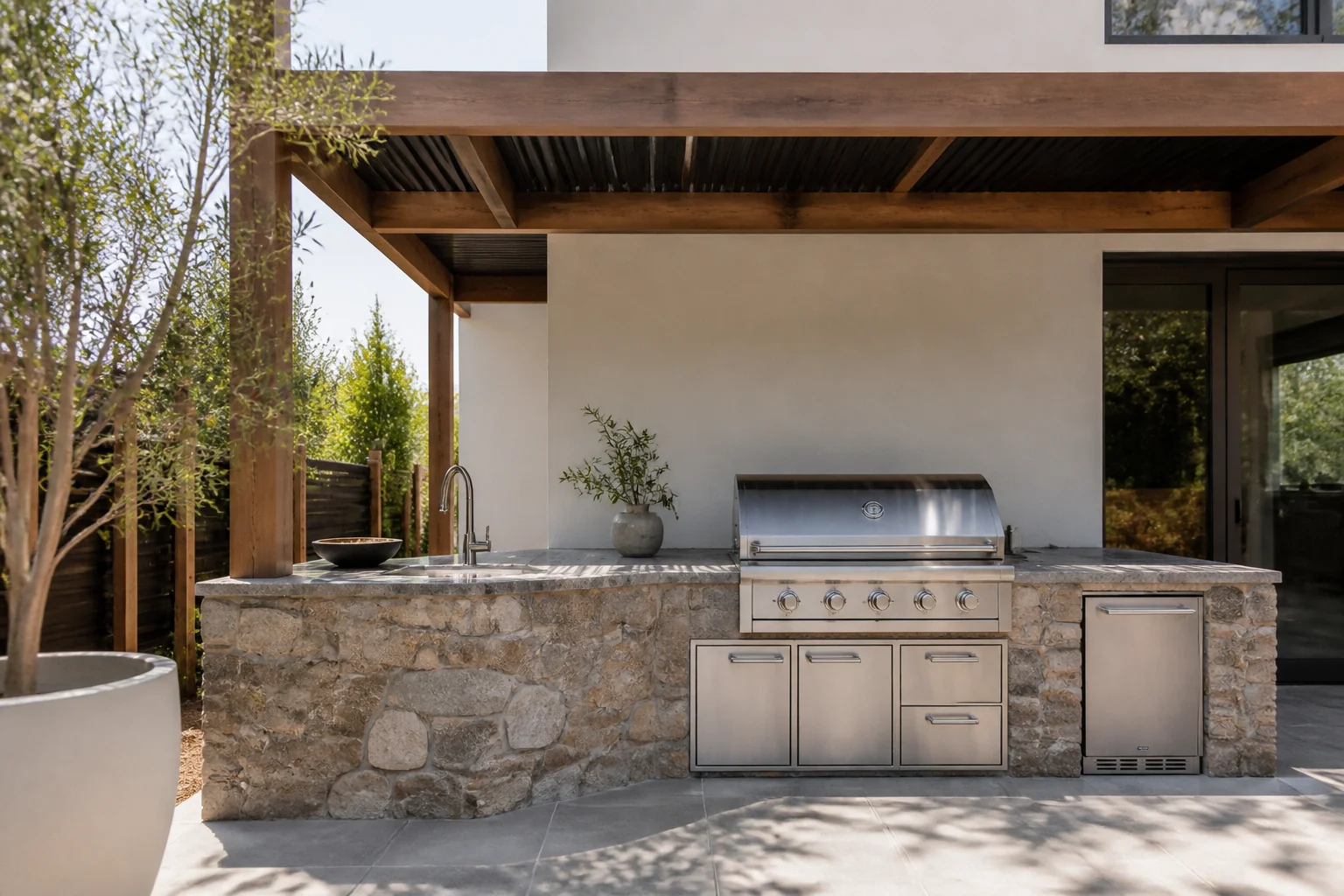
What the work actually covers
An outdoor kitchen is a run of masonry or cabinetry carrying a grill, a counter and somewhere to put a plate down. What separates the ones that get used from the ones that do not is shelter, counter space either side of the heat, and being close enough to the house that nobody is carrying trays across a lawn. Taken in Japandi, the elements on the list — grill and burners, counter surface and run, base cabinetry or masonry, overhead shelter — are the ones carrying the look, and storage. japandi is a promise about empty surfaces, so the remodel has to provide somewhere for everything to go out of sight.
Making a outdoor kitchen remodel read as Japandi
Japandi asks for empty surfaces, low horizontals and a palette that stays inside five tones. In a remodel it is unusually demanding, because clear counters and hidden storage have to be built in rather than tidied into place. Against a outdoor kitchen remodel that means the pieces doing the visible work are low platform bed or sofa, slatted timber screen, handthrown ceramic vessels, sitting inside whatever the layout already demands.
Palette and materials
Japandi holds a narrow range: Rice Paper, Raw Linen, Clay Grey, Charred Oak, Sumi Ink, with materials running to white oak, blackened timber, handmade ceramic, raw linen. On a outdoor kitchen remodel the discipline matters most wherever the largest uninterrupted surface is — keep that inside the range and every smaller decision gets easier.
Dimensions that do not move
A style choice never overrides the geometry. Whatever the finishes, the work still has to hold: Give the grill 24in of counter on one side and 36in on the other — the landing space is what makes it usable. Keep the whole run within about 20ft of the kitchen door, or it stops being used on a weeknight. Allow 42in of clear standing space in front of the counter; 48in where people pass behind the cook.
Lighting
Diffused through paper or fabric, concealed where possible. Hard shadows are the thing this style is arranged to avoid. Two layers, both dimmable and warm. Task light directly over the grill and the counter, bright enough to see whether meat is done, and a low ambient layer over the eating area. Anything mounted high and aimed outward turns the patio into a stage and kills the evening.
Where it usually goes wrong
The style breaks on visible clutter, high-gloss finishes, cool blue-white bulbs. Independent of any style, this project is most often let down by a grill with no counter beside it, so everything is carried back indoors anyway. no shelter, which limits the whole thing to about four months a year.
If the space is tight
A 6ft run with a built-in grill, counter on both sides and a light over it beats a sprawling island nobody sheltered. Depth matters more than length — 30in gives you a working counter, 24in gives you a shelf. Storage. Japandi is a promise about empty surfaces, so the remodel has to provide somewhere for everything to go out of sight.
Questions
- Does Japandi work for a small outdoor kitchen?
- A 6ft run with a built-in grill, counter on both sides and a light over it beats a sprawling island nobody sheltered. Depth matters more than length — 30in gives you a working counter, 24in gives you a shelf. Japandi is helped by that, since japanese restraint with nordic warmth, each keeping the other honest.
- Which surface matters most in a japandi outdoor kitchen?
- Storage. Japandi is a promise about empty surfaces, so the remodel has to provide somewhere for everything to go out of sight.
- Can I see this on my own outdoor kitchen?
- Yes. Upload a photo of the room and the Studio remodels it in Japandi. New accounts get 4 credits and a Standard run costs 4, so there is a full render before anything is paid for.
- What ruins a japandi scheme?
- Usually visible clutter and high-gloss finishes.