Shaker playroom remodel
Everything necessary, nothing more, made properly. What that means for a playroom remodel — what changes, the palette, the dimensions worth checking — and how to try it on a photo of your own room.
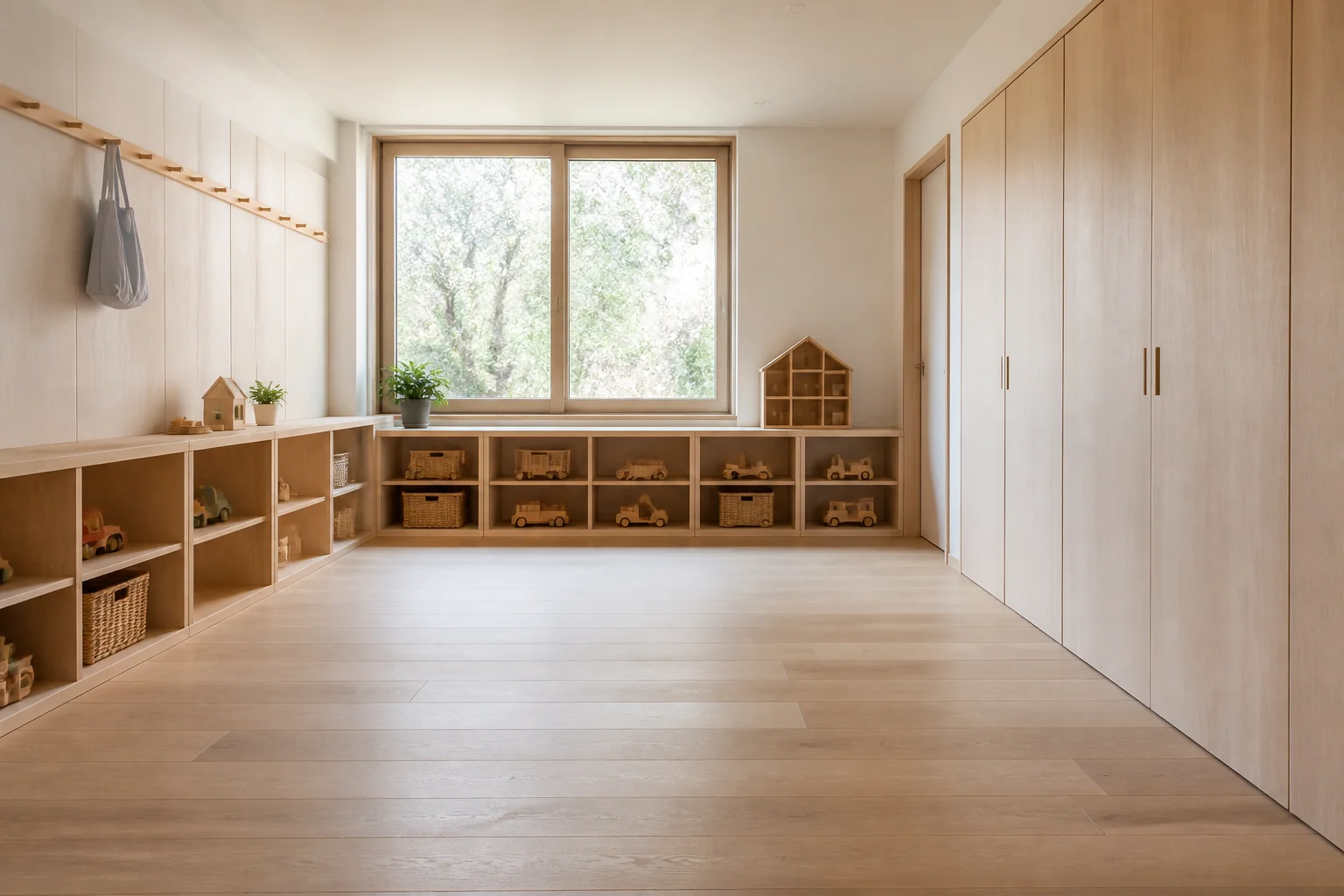
What the work actually covers
A playroom remodel is storage and surface. Low open storage that a child can use without help, a floor warm enough to sit on, and walls that survive — the rest is deciding how much of the room stays clear. Taken in Shaker, the elements on the list — low open storage, floor covering, wall protection or paint, table and seating — are the ones carrying the look, and door frame width and peg rails. shaker is a set of proportions, and a slightly wrong stile width shows immediately.
Making a playroom remodel read as Shaker
Shaker is a joinery style before it is a decorating one: flat-panel doors, peg rails, honest timber and no applied decoration. It is the safest cabinet language in a remodel because it sits comfortably in period and modern houses alike. Against a playroom remodel that means the pieces doing the visible work are peg rail running the wall, flat-panel cabinetry, ladder-back chair, sitting inside whatever the layout already demands.
Palette and materials
Shaker holds a narrow range: Milk White, Buttermilk, Shaker Blue, Sage, Barn Brown, with materials running to cherry and maple, milk paint, woven tape seating, cast iron hardware. On a playroom remodel the discipline matters most wherever the largest uninterrupted surface is — keep that inside the range and every smaller decision gets easier.
Dimensions that do not move
A style choice never overrides the geometry. Whatever the finishes, the work still has to hold: Keep storage under 40in so a child can reach the top shelf. Leave at least half the floor completely clear — the empty part is where play happens. A play table sits at 20–22in with 12in chairs for under-sixes.
Lighting
Simple and warm — plain shades, no ornament, positioned where the work is. Even and bright, because play happens on the floor and shadows fall across it. Skip anything fragile at low level, and put the room on a dimmer so it can be wound down at the end of the day.
Where it usually goes wrong
The style breaks on carving and moulding, bright colour, visible clutter. Independent of any style, this project is most often let down by adult-height shelving, so an adult puts everything away. the floor filled edge to edge, leaving nowhere to actually play.
If the space is tight
In a small playroom, take one full wall for floor-to-40in storage and leave the other three completely empty. Splitting storage across several walls eats the clear floor from every direction at once. Door frame width and peg rails. Shaker is a set of proportions, and a slightly wrong stile width shows immediately.
Questions
- Does Shaker work for a small playroom?
- In a small playroom, take one full wall for floor-to-40in storage and leave the other three completely empty. Splitting storage across several walls eats the clear floor from every direction at once. Shaker is helped by that, since everything necessary, nothing more, made properly.
- Which surface matters most in a shaker playroom?
- Door frame width and peg rails. Shaker is a set of proportions, and a slightly wrong stile width shows immediately.
- Can I see this on my own playroom?
- Yes. Upload a photo of the room and the Studio remodels it in Shaker. New accounts get 4 credits and a Standard run costs 4, so there is a full render before anything is paid for.
- What ruins a shaker scheme?
- Usually carving and moulding and bright colour.