Shaker outdoor kitchen remodel
Everything necessary, nothing more, made properly. What that means for a outdoor kitchen remodel — what changes, the palette, the dimensions worth checking — and how to try it on a photo of your own room.
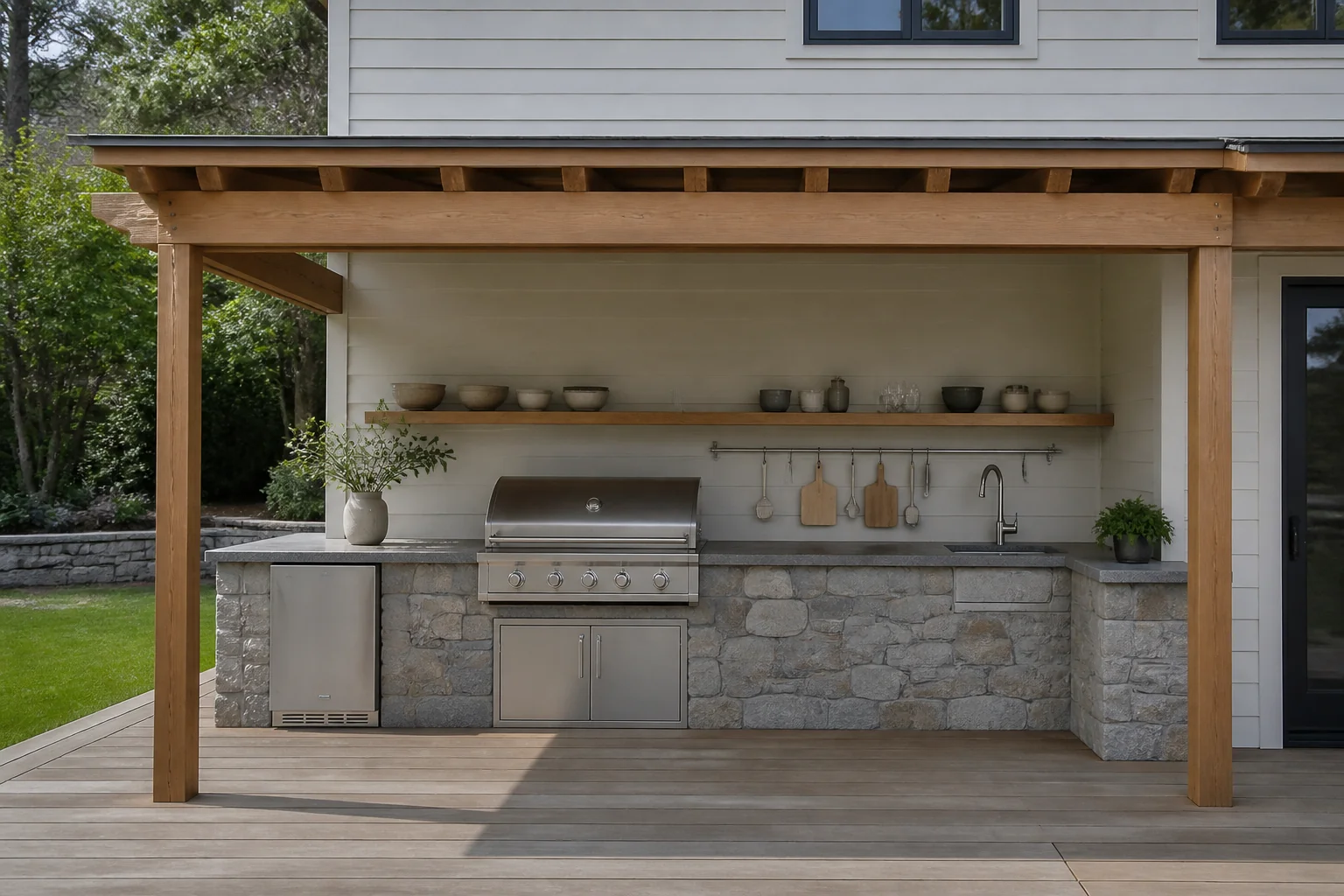
What the work actually covers
An outdoor kitchen is a run of masonry or cabinetry carrying a grill, a counter and somewhere to put a plate down. What separates the ones that get used from the ones that do not is shelter, counter space either side of the heat, and being close enough to the house that nobody is carrying trays across a lawn. Taken in Shaker, the elements on the list — grill and burners, counter surface and run, base cabinetry or masonry, overhead shelter — are the ones carrying the look, and door frame width and peg rails. shaker is a set of proportions, and a slightly wrong stile width shows immediately.
Making a outdoor kitchen remodel read as Shaker
Shaker is a joinery style before it is a decorating one: flat-panel doors, peg rails, honest timber and no applied decoration. It is the safest cabinet language in a remodel because it sits comfortably in period and modern houses alike. Against a outdoor kitchen remodel that means the pieces doing the visible work are peg rail running the wall, flat-panel cabinetry, ladder-back chair, sitting inside whatever the layout already demands.
Palette and materials
Shaker holds a narrow range: Milk White, Buttermilk, Shaker Blue, Sage, Barn Brown, with materials running to cherry and maple, milk paint, woven tape seating, cast iron hardware. On a outdoor kitchen remodel the discipline matters most wherever the largest uninterrupted surface is — keep that inside the range and every smaller decision gets easier.
Dimensions that do not move
A style choice never overrides the geometry. Whatever the finishes, the work still has to hold: Give the grill 24in of counter on one side and 36in on the other — the landing space is what makes it usable. Keep the whole run within about 20ft of the kitchen door, or it stops being used on a weeknight. Allow 42in of clear standing space in front of the counter; 48in where people pass behind the cook.
Lighting
Simple and warm — plain shades, no ornament, positioned where the work is. Two layers, both dimmable and warm. Task light directly over the grill and the counter, bright enough to see whether meat is done, and a low ambient layer over the eating area. Anything mounted high and aimed outward turns the patio into a stage and kills the evening.
Where it usually goes wrong
The style breaks on carving and moulding, bright colour, visible clutter. Independent of any style, this project is most often let down by a grill with no counter beside it, so everything is carried back indoors anyway. no shelter, which limits the whole thing to about four months a year.
If the space is tight
A 6ft run with a built-in grill, counter on both sides and a light over it beats a sprawling island nobody sheltered. Depth matters more than length — 30in gives you a working counter, 24in gives you a shelf. Door frame width and peg rails. Shaker is a set of proportions, and a slightly wrong stile width shows immediately.
Questions
- Does Shaker work for a small outdoor kitchen?
- A 6ft run with a built-in grill, counter on both sides and a light over it beats a sprawling island nobody sheltered. Depth matters more than length — 30in gives you a working counter, 24in gives you a shelf. Shaker is helped by that, since everything necessary, nothing more, made properly.
- Which surface matters most in a shaker outdoor kitchen?
- Door frame width and peg rails. Shaker is a set of proportions, and a slightly wrong stile width shows immediately.
- Can I see this on my own outdoor kitchen?
- Yes. Upload a photo of the room and the Studio remodels it in Shaker. New accounts get 4 credits and a Standard run costs 4, so there is a full render before anything is paid for.
- What ruins a shaker scheme?
- Usually carving and moulding and bright colour.